
What Is Semax? A Researcher’s Introduction to the Heptapeptide
Semax is a synthetic heptapeptide, a seven-amino-acid chain (Met-Glu-His-Phe-Pro-Gly-Pro) derived from a fragment of adrenocorticotropic hormone (ACTH 4-10) and extended with a stabilizing Pro-Gly-Pro tail. That tail matters. It slows enzymatic breakdown, giving the molecule a far longer functional lifespan than the native fragment. Researchers study the semax research peptide for its interaction with neurotrophic signaling pathways, particularly those involving brain-derived neurotrophic factor (BDNF), and for its effects on neurotransmitter systems in experimental models.
For engineers and technical buyers accustomed to specifying materials by structure and performance, the same discipline applies here. Sequence integrity, purity, and stability define whether a peptide behaves predictably in a study, and any credible supplier should be able to document its technical characterization data. This article explains what Semax is, how its structure drives its mechanism, where it is studied, and what quality and handling standards support reliable research use. It is intended for laboratory research only.
What Semax Means: A Plain-Language Definition of the Heptapeptide
Origin and Development
Semax was developed in Russia during the 1980s at the Institute of Molecular Genetics of the Russian Academy of Sciences. Researchers started from ACTH(4-10), a short fragment of adrenocorticotropic hormone that showed effects on learning and attention in animal studies without the hormonal activity of the full ACTH molecule. The unmodified fragment, however, is broken down quickly by peptidases in biological systems, which limits its usefulness as a research tool.
To address this, the team attached a Pro-Gly-Pro tripeptide to the fragment. The resulting analog resisted enzymatic degradation far better than the parent sequence while retaining its characteristic activity. A few terms help frame this history:
- Heptapeptide
- A peptide made up of seven amino acids linked in a defined order.
- Peptide analog
- A synthetic peptide modified from a natural sequence to alter properties such as stability or potency.
- ACTH fragment
- A short segment of the 39-amino-acid adrenocorticotropic hormone, here the residues at positions 4 through 10.
- Amino acid sequence
- The ordered arrangement of residues in a peptide, which determines its structure and behavior.
- Neuropeptide
- A peptide that influences the activity of neurons or nervous system signaling.
Since its introduction, Semax has been studied primarily within Russian research programs, and its regulatory status continues to differ between jurisdictions.
How Semax Is Built and How It Works
Molecular Structure and Stability
Semax is built from seven amino acid residues, and its sequence is commonly written as Met-Glu-His-Phe-Pro-Gly-Pro. The first four residues, Met-Glu-His-Phe, correspond to positions 4 through 7 of ACTH. The final Pro-Gly-Pro tail is the engineered element. It is a short tripeptide that is not part of the native ACTH(4-10) fragment.
That tail matters because short, unmodified peptides are typically cleared quickly. Exopeptidases and other proteolytic enzymes cut them down within minutes in biological media. Adding Pro-Gly-Pro at the C-terminus is a recognized strategy for slowing that breakdown, since the proline-rich ending is a poor fit for many common peptidases. The result is a molecule with greater resistance to enzymatic degradation than its parent fragment, which is the main reason the analog was designed this way.
In practical terms, stability means more than enzyme resistance. Peptides are also sensitive to heat, moisture, light, and repeated freeze-thaw cycles. Methionine, for instance, is prone to oxidation. For this reason, research materials are generally supplied as lyophilized powder and kept cold and dry, while reconstituted solutions are used promptly and handled under controlled conditions. Careful storage preserves the integrity of the sequence, which in turn protects the reproducibility of any experiment that depends on it.
Proposed Mechanisms Under Investigation
Published research on Semax points to several overlapping biological activities, though the picture remains incomplete. Preclinical studies indicate that the peptide may influence the expression of neurotrophic factors, most notably brain-derived neurotrophic factor (BDNF) and its receptor, tropomyosin receptor kinase B (TrkB). In rodent models, changes in BDNF levels have been reported in regions such as the hippocampus following administration, which has drawn interest because these pathways are tied to neuronal survival and plasticity.
A second line of investigation concerns neurotransmitter systems. Studies suggest Semax may modulate dopaminergic and serotonergic activity, although the magnitude and consistency of these effects vary between experimental designs.
Researchers have also examined gene expression changes. Transcriptome analyses in animal models of ischemia report altered activity in genes linked to immune response, vascular function, and neurotrophin signaling, which is consistent with the neuroprotective hypotheses explored in cerebrovascular research.
Two cautions apply. First, much of this evidence comes from animal and in vitro work, so findings should not be extrapolated directly to other settings. Second, the precise receptor-level mechanism has not been conclusively established. Semax is not known to act through a single, fully characterized target, and the relative contribution of each proposed pathway remains an open question. These mechanisms are best described as working hypotheses under active study.
Where Semax Is Used in Research

Semax is studied across several preclinical and early-stage research contexts, and it helps to be precise about what each one examines. These are research applications only, not therapeutic or medical claims. The evidence base varies considerably by area, and much of it comes from animal models and small studies rather than large, independently replicated trials.
The main areas of investigation include:
- Neuroprotection models: examine whether the peptide influences neuronal survival under experimental stress such as hypoxia or ischemia.
- Cognitive function studies: assess effects on learning, memory, and attention in controlled laboratory paradigms.
- Cerebrovascular research: investigates responses in models of impaired cerebral blood flow and stroke-related injury.
- Gene expression and neurotrophic signaling: explores changes in markers such as BDNF and related pathways.
Interpretation requires care. Published findings are heterogeneous in design, dose, and endpoints, and a result in a rodent model does not establish an effect in humans. Many reports also originate from a limited number of research groups, which makes independent replication especially valuable.
In the research setting, Semax is commonly supplied as a lyophilized (freeze-dried) powder or, less often, as a prepared solution. Lyophilized material generally offers better long-term stability and is reconstituted for use, while solutions are more convenient but typically more sensitive to degradation over time. Which form suits a given protocol depends on the experimental design, storage capability, and the analytical documentation available for the lot in question.
Quality, Purity, and Handling Considerations for Peptide Research Materials
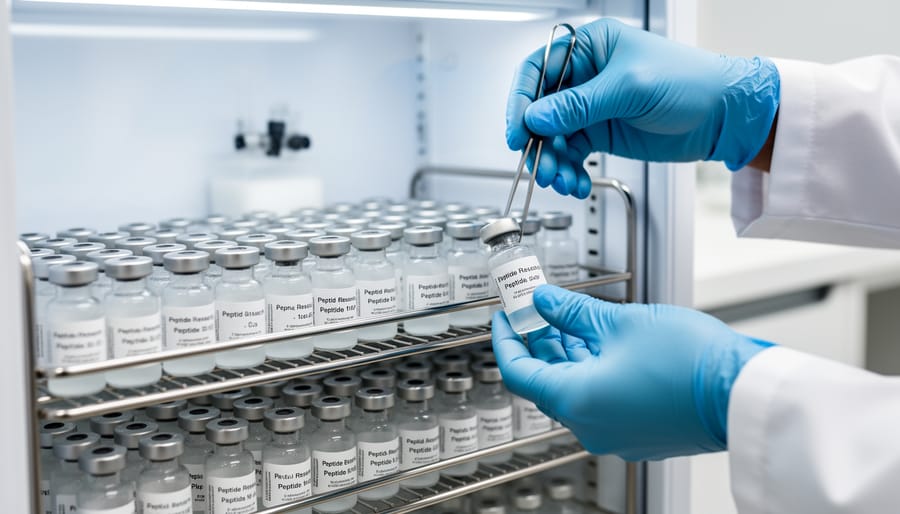
Reproducible peptide research starts with knowing exactly what is in the vial. A heptapeptide like Semax is only as reliable as its verified identity and purity, and small deviations in either can quietly distort results. That is why analytical documentation matters. High-performance liquid chromatography (HPLC) estimates purity by separating the target peptide from synthesis by-products, while mass spectrometry confirms that the molecular weight matches the expected seven-residue sequence. Together they show whether you are working with the compound you think you are.
Storage is the second variable. Peptides are sensitive to heat, moisture, and repeated freeze-thaw cycles, so lyophilized material is typically kept cold, dry, and protected from light, with reconstituted solutions handled more cautiously. Documented conditions let researchers trace any change in performance back to a cause.
This discipline will feel familiar to anyone in compound development. In custom rubber formulation, batch consistency and thorough characterization determine whether a part performs under load, heat, and wear. The same logic underpins our focus on materials quality and it reflects a broader commitment to quality that treats validation as non-negotiable rather than optional.
Specialized needs call for tailored specifications, whether that means a defined purity threshold for a peptide or a precise cure profile for an elastomer. Our approach to customized materials follows the same principle: define the requirement, verify it, and document it.

Frequently Asked Questions About Semax
What kind of molecule is Semax?
Semax is a synthetic heptapeptide, a chain of seven amino acids, designed as an analog of an ACTH fragment. It is a peptide, not a protein or a small-molecule compound.
Is Semax the same as ACTH?
No. ACTH is a much longer endogenous hormone, while Semax is a short synthetic analog built from a fragment of it, with an added stabilizing sequence.
What is its regulatory status?
It varies by jurisdiction. Rules differ between countries, so researchers should confirm the requirements that apply to them before sourcing or handling the material.
Why is stability a concern for peptides?
Peptides are susceptible to enzymatic and chemical degradation, which can alter the material between synthesis and use. Controlled storage and verified purity help keep results reproducible.
These answers describe Semax as a research compound only and are not medical guidance. For applications beyond the research setting, defer to qualified professionals and the regulations that govern your location.
Semax is a synthetic heptapeptide, a seven-amino-acid chain built on an ACTH(4-10) fragment and stabilized with a Pro-Gly-Pro tail so it resists enzymatic breakdown. Preclinical research points to effects on neurotrophic signaling and neurotransmitter systems, and it is studied in neuroprotection, cognition, and cerebrovascular models. Much of that evidence is still preliminary, so findings deserve careful, evidence-based interpretation rather than broad conclusions.
The same discipline applies to the materials themselves. Verified purity, documented analysis, and controlled storage are what make research reproducible. At The Rubber Associates, that commitment to rigorous characterization and quality drives our innovation and our custom solutions. If you have a specialized material need, our team is ready to help you define the right specification.
