
Why Commitment to Quality Defines Long-Term Success in Rubber Manufacturing
Commitment to quality in rubber manufacturing translates directly into measurable outcomes: reduced failure rates, extended component lifecycles, and verifiable performance under the harshest operating conditions. This commitment manifests through ISO 9001:2015-certified quality management systems, rigorous material testing at every production stage, and documented traceability from raw compound formulation through final inspection. For procurement teams evaluating suppliers in 2026, understanding what separates genuine quality frameworks from surface-level compliance determines whether components will meet specifications in automotive powertrains, industrial machinery, or extreme-temperature applications.
The distinction lies in how quality permeates every decision point. Leading manufacturers implement incoming material certification, in-process dimensional verification using coordinate measuring machines, and post-cure property testing that validates hardness, tensile strength, and elongation against design parameters. These protocols aren’t bureaucratic checkboxes. They prevent the costly failures that occur when a seal degrades prematurely in a hydraulic system or when a vibration isolator loses elasticity under thermal cycling.
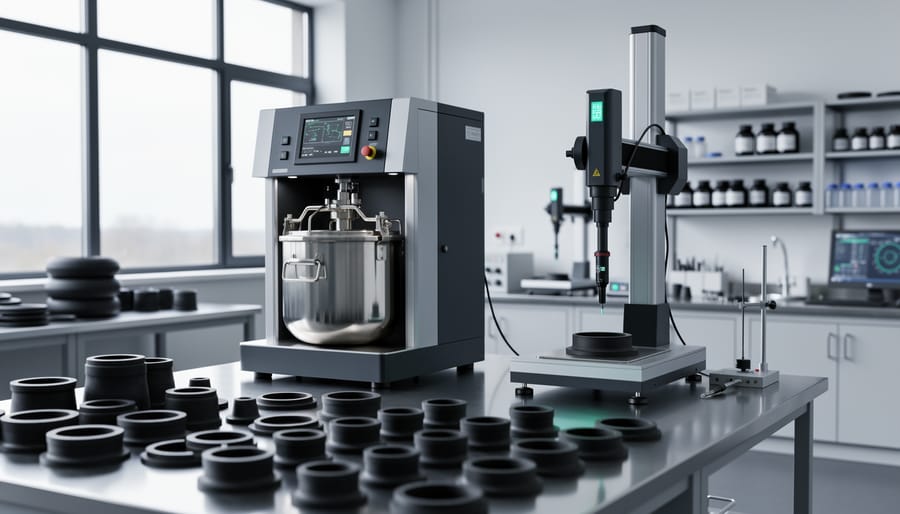
Quality commitment also drives innovation in process capabilities. Advanced mixing technologies ensure uniform compound dispersion, precision molding equipment maintains tolerances within ±0.05mm, and custom tooling development addresses application-specific challenges that standard solutions cannot accommodate. For engineers specifying components where performance directly affects operational uptime, these capabilities represent the foundation of reliable supply partnerships that extend beyond initial procurement into long-term collaboration on continuous improvement.
The Foundation of Quality Commitment in Rubber Technology
A genuine quality commitment in rubber manufacturing rests on three interconnected pillars: systematic process controls, rigorous material standards, and an organizational culture where every team member, from rubber technologists to production operators, shares accountability for outcomes. Unlike superficial quality claims, this foundation manifests in documented procedures, measurable criteria, and continuous verification at each manufacturing stage.
Material selection standards form the first critical element. Quality-committed manufacturers establish precise specifications for raw rubber polymers, fillers, curatives, and processing aids, then verify each incoming batch against those criteria before production begins. This includes validating polymer molecular weight distributions, carbon black particle sizes, and accelerator purity levels, parameters that directly influence final product performance under stress, temperature cycling, and chemical exposure.
Systematic process controls extend quality frameworks from compound development through final inspection. During formulation, technologists document mixing sequences, temperature profiles, and rheometer data to ensure reproducibility. Production teams follow validated protocols for molding temperatures, cure times, and cooling rates, with statistical process control identifying variations before they produce non-conforming parts. Each step includes defined acceptance criteria and documented responses when parameters drift outside tolerances.
The cultural dimension proves equally vital. Organizations with authentic quality commitment empower employees to halt production when issues arise, invest in ongoing technical training, and implement root-cause analysis for every defect rather than quick fixes. Quality meetings review trend data, customer feedback, and failure analysis results to drive continuous improvement in materials, processes, and testing methods.
This integrated approach creates a quality framework that functions across the entire product lifecycle. Specifications established during compound development inform incoming material checks, production controls reference formulation parameters, and field performance data feeds back into next-generation compound improvements, creating a closed-loop system where quality drives both consistency and innovation.
Quality Control Throughout the Manufacturing Process
Material Verification and Compound Development
Material verification begins before raw materials enter the facility. Quality-committed manufacturers conduct incoming inspections on every batch of polymers, fillers, and additives, testing them against documented specifications for properties like viscosity, particle size distribution, and chemical composition. This gatekeeping prevents substandard materials from contaminating production runs and ensures traceability throughout the manufacturing process.
Compound development translates customer requirements into precise formulations through systematic testing. Engineers select base polymers and additives based on the application’s temperature range, chemical exposure, and mechanical demands. Each experimental batch undergoes laboratory testing to validate hardness, tensile strength, elongation, and resilience before scaling to production volumes. For critical automotive and industrial applications requiring specification rubber this development phase includes accelerated aging tests and environmental exposure simulations that predict long-term performance.
The formulation becomes a controlled document with locked mixing parameters, ingredient ratios, mixing temperatures, and cycle times, that production teams must follow precisely. Any deviation triggers a quality review before processing continues, maintaining consistency across production runs.
In-Process Monitoring and Adjustments
During production, quality teams monitor critical parameters continuously to catch deviations before they become defects. Temperature control stands as the most scrutinized variable, rubber compounds cure within narrow thermal windows, typically ±3°F of target specifications. Digital monitoring systems track mold temperatures, mixing chamber heat, and ambient conditions, triggering alerts when readings drift outside acceptable ranges.
Cure time verification involves precise tracking of vulcanization cycles. Operators measure rheometer outputs to confirm optimal cross-linking density, adjusting press times or temperatures when viscosity curves indicate incomplete or excessive cure. These real-time measurements prevent under-cured parts that fail prematurely or over-cured components that become brittle.
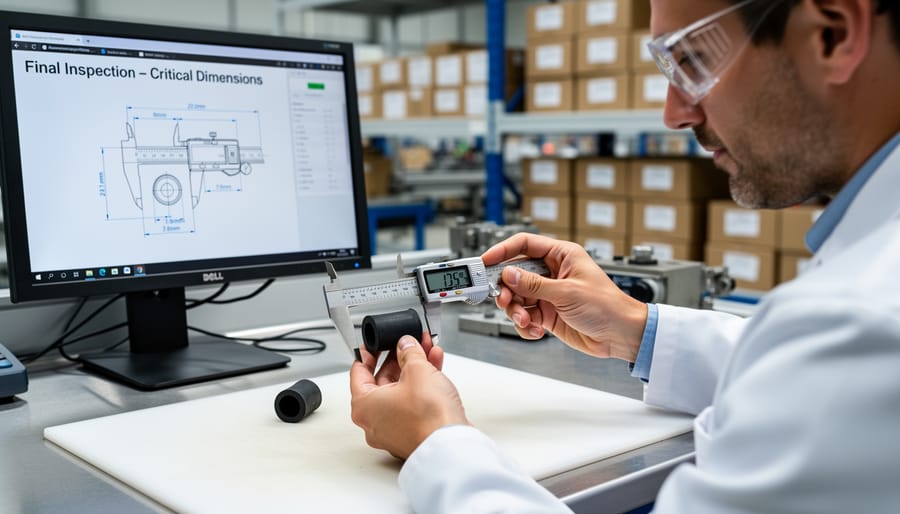
Dimensional checks occur at multiple production stages. First-piece inspections verify that tooling produces parts within tolerance before full runs begin. Statistical sampling during production confirms dimensional stability, with coordinate measuring machines validating complex geometries to ±0.001 inch in critical applications.
When process variations appear, quality teams follow established protocols. Minor temperature fluctuations may require simple thermostat adjustments. Significant deviations trigger production holds while engineers investigate root causes, worn tooling, material batch inconsistencies, or equipment calibration drift. Documentation of every adjustment creates accountability and identifies patterns that inform preventive maintenance schedules.
This vigilant monitoring approach prevents waste while maintaining the consistency automotive and industrial applications demand, where even small variations can compromise assembly fit or performance under stress.
Testing Protocols for High-Wear and Automotive Applications
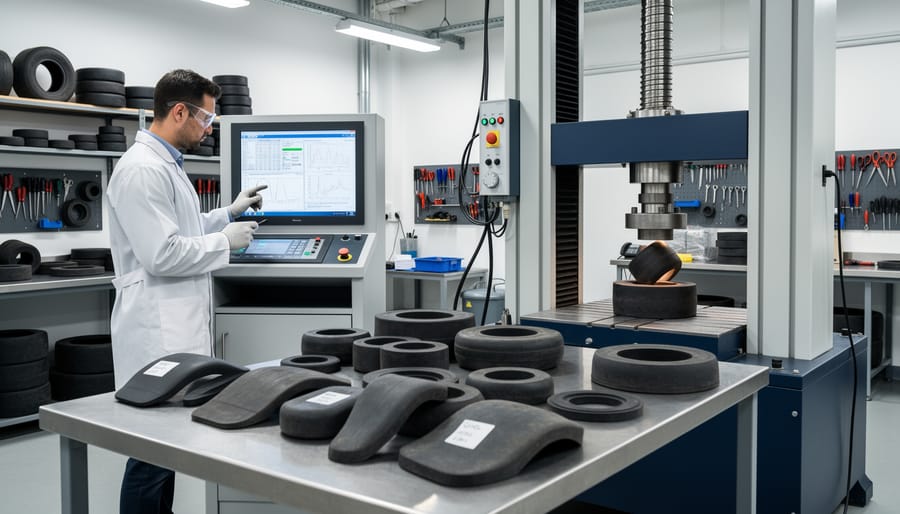
Testing protocols for automotive and high-wear rubber components go far beyond basic quality checks, they simulate years of real-world stress in controlled environments to validate performance before parts ever reach production lines. Manufacturers serving these sectors implement multi-stage testing regimens that measure how compounds respond to the mechanical, thermal, and chemical punishment typical of engines, suspensions, and industrial machinery.
Abrasion resistance testing replicates wear patterns from constant friction against metal surfaces, abrasive particles, or other components. Taber abraders and rotating drum tests quantify material loss over specified cycles, with automotive seals typically required to maintain dimensional tolerances after 100,000+ cycles. Temperature cycling protocols expose samples to extreme swings, from -40°C cold starts to 150°C+ operating temperatures, to verify that compounds retain flexibility and sealing integrity across the thermal range. These tests often run continuously for weeks, checking for hardening, cracking, or permanent deformation.
Chemical exposure testing submerges rubber samples in automotive fluids, industrial solvents, or ozone chambers to measure volume swell, tensile strength degradation, and surface deterioration. Specifications vary by application: fuel system components face gasoline and ethanol blends, while hydraulic seals must resist phosphate esters and synthetic oils without leaching additives. ASTM D430 fatigue testing subjects components to repetitive flexing or compression cycles that mirror real-world loading patterns, identifying failure points before they occur in service.
| Test Standard | Application Area | Critical Metrics |
|---|---|---|
| ASTM D2000 | Automotive seals and gaskets | Tensile strength, elongation, compression set, fluid resistance |
| ISO 37 | General elastomer tensile properties | Ultimate tensile strength, elongation at break, modulus |
| ASTM D624 | Industrial belts and conveyor systems | Tear strength, cut growth resistance |
| SAE J200 | Engine mounts and vibration dampeners | Dynamic stiffness, heat aging, ozone resistance |
Automotive OEMs increasingly require suppliers to hold ISO/TS 16949 certification (now IATF 16949), which mandates documented testing at incoming material, in-process, and final inspection stages. Performance benchmarks are application-specific: a transmission seal might require less than 5% volume swell after 1000 hours in ATF at 150°C, while an industrial roller needs to maintain shore hardness within ±3 points after prolonged ozone exposure. These stringent validation protocols ensure rubber components meet durability expectations measured in years and millions of cycles, not just initial specification compliance.
Custom Solutions and Quality Assurance
Custom rubber solutions present unique quality assurance challenges because standard testing protocols rarely address application-specific performance requirements. When a customer needs a component that withstands simultaneous chemical exposure, temperature extremes, and mechanical stress, quality commitment means developing validation methods that replicate those exact conditions rather than applying generic industry tests.
The collaborative specification process begins with detailed failure analysis of existing components or competitive products. Engineers examine wear patterns, chemical degradation, and mechanical failures to identify root causes. This investigation establishes baseline performance requirements and reveals critical quality parameters that standard specifications might overlook. For components facing extreme wear this might include multi-axis abrasion testing or accelerated aging under application-specific chemical exposure.
Quality criteria for custom solutions typically combine industry standards with customer-defined benchmarks. A mining equipment seal might require ASTM D2000 compliance alongside proprietary tests simulating actual mineral slurry contact and pressure cycling experienced in service. Documentation becomes critical, every specification decision, material selection rationale, and test parameter must be traceable to application requirements.
Validation protocols for custom rubber products often involve iterative testing cycles. Initial prototypes undergo laboratory evaluation against established criteria, followed by field trials in actual operating conditions. Quality teams monitor both laboratory metrics and real-world performance data, adjusting compound formulations or processing parameters when results diverge from targets. This feedback loop ensures that quality assurance evolves with application understanding rather than remaining static after initial approval.
Innovation and Continuous Quality Improvement
Quality commitment and innovation exist in a symbiotic relationship, rigorous quality data reveals performance gaps that drive material advancement, while new compounds must prove themselves through equally rigorous validation. In rubber manufacturing for 2026’s demanding applications, this feedback loop separates incremental improvement from breakthrough solutions.
Failure analysis exemplifies this dynamic. When a component underperforms in high-wear environments, quality-committed manufacturers don’t simply replace it, they conduct root cause investigation. Was the failure compound-related, process-induced, or application-specific? This forensic approach generates actionable insights: perhaps a thermoplastic elastomer formulation needs enhanced UV stabilizers, or a traditional rubber compound requires modified crosslink density for improved fatigue resistance. Each analyzed failure becomes a development opportunity.
Modern manufacturers capture quality data at unprecedented granularity. Real-time process monitoring during compound mixing reveals subtle relationships between processing parameters and final properties. Accelerated aging tests on new formulations predict long-term performance before full-scale production. This data doesn’t merely confirm specifications, it identifies promising directions for next-generation materials, from advanced rubber compounds with superior chemical resistance to hybrid materials that combine elastomeric properties with thermoplastic processability.
The development cycle for innovative materials demonstrates quality commitment in action. A new automotive sealing compound might undergo thousands of hours of temperature cycling, compression set testing under varied conditions, and exposure to automotive fluids before customer trials begin. Engineers refine formulations based on these results, adjusting filler systems or cure packages until performance exceeds application requirements.
This disciplined approach to innovation yields materials that don’t just meet current needs, they anticipate future demands. Quality data from today’s applications informs compounds that will solve tomorrow’s engineering challenges, creating a continuous improvement trajectory that benefits customers across automotive, industrial, and specialized sectors.
The Business Impact of Quality Commitment

The financial advantages of quality commitment extend far beyond upfront manufacturing costs. Organizations that partner with quality-focused rubber suppliers consistently report lower total cost of ownership, even when initial pricing appears higher than commodity alternatives. This cost differential manifests across multiple operational dimensions that directly impact the bottom line.
Warranty claims and product failures represent significant hidden expenses in industrial applications. A quality-committed supplier delivering rubber components with 98% defect-free rates versus 92% eliminates thousands of dollars in replacement costs, emergency shipments, and production disruptions. For automotive applications where a single component failure can trigger assembly line shutdowns, this reliability translates to measurable operational savings and protected production schedules.
Customer retention rates provide another clear indicator of quality commitment’s business value. Industrial buyers evaluating rubber suppliers prioritize consistency and performance over transactional price considerations. Organizations demonstrating sustained quality delivery command premium pricing power while maintaining multi-year partnerships that reduce customer acquisition costs and stabilize revenue streams.
The measurable outcomes of sustained quality commitment include:
- Lower defect rates reducing scrap, rework, and customer complaints
- Extended product lifecycle minimizing replacement frequency and inventory costs
- Reduced equipment downtime through reliable component performance
- Enhanced brand reputation attracting premium customers and top-tier applications
Market differentiation becomes particularly valuable in competitive bidding situations. Engineering teams specifying rubber components for critical applications increasingly request quality documentation, testing protocols, and process certifications that commodity suppliers cannot provide. This qualification advantage opens doors to high-value contracts in aerospace, medical, and advanced automotive applications where quality commitment serves as a mandatory entry requirement rather than a preference.
Quality commitment separates transactional suppliers from true manufacturing partners. It’s not a certification earned once and displayed indefinitely, it’s a daily discipline embedded in compound selection, process monitoring, customer collaboration, and continuous improvement. Organizations that sustain quality focus through market cycles, technology shifts, and competitive pressures earn trust that marketing claims alone cannot replicate.
At Rubber Associates, this commitment manifests in every engineering consultation and custom solution we develop. Our team applies decades of rubber technology expertise to match materials and designs precisely to application demands, whether that’s extreme temperature cycling in automotive systems or abrasion resistance in industrial environments. We don’t offer generic catalog products; we engineer rubber components that perform reliably under the specific stresses your application presents.
This approach demands rigorous testing, transparent communication about material capabilities and limitations, and accountability when performance matters most. The result isn’t just products that meet specifications, it’s partnerships where customers trust our recommendations because they’re grounded in proven quality systems and real-world application knowledge.
For industries where component failure carries significant consequences, working with suppliers who treat quality as fundamental philosophy, not optional feature, makes the difference between reliable operation and costly downtime.
