
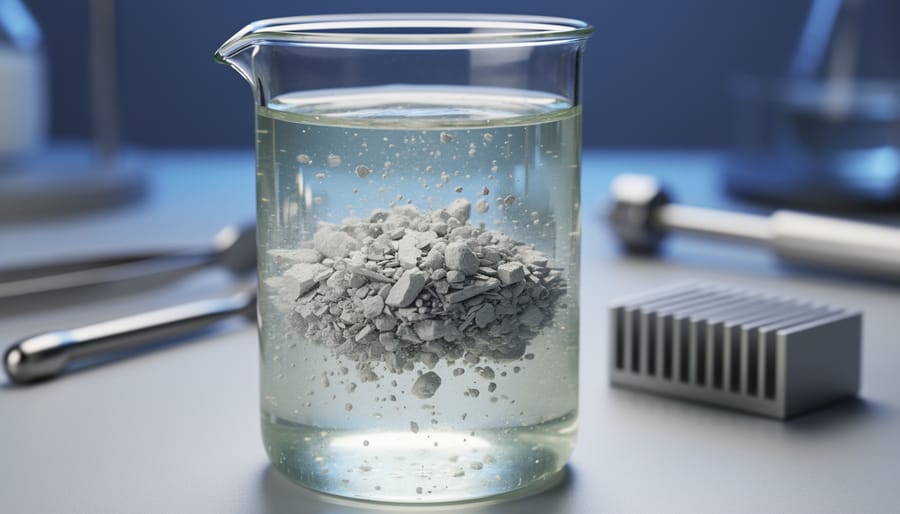
How to Choose Thermal Fillers for Thermoplastic Silicone: A Buying Guide
Thermal fillers function as the backbone of high-performance thermoplastic silicone formulations, serving three critical roles: amplifying thermal conductivity to meet demanding heat dissipation requirements, reducing material costs without compromising functionality, and modifying mechanical properties to achieve application-specific performance targets. For engineers specifying materials in automotive thermal management systems or industrial electronics cooling, selecting the right filler type, particle size distribution, and loading percentage determines whether a component meets its thermal interface specifications or fails under real-world operating conditions.
The decision extends beyond simply choosing aluminum oxide over boron nitride or ceramic over metallic fillers. Loading levels, surface treatments, aspect ratios, and compatibility with your silicone matrix directly impact processability, long-term reliability, and thermal cycling performance. A poorly specified filler can trigger settling issues during manufacturing, create abrasive wear in molds, or compromise electrical insulation in power electronics assemblies.
This guide addresses the complete specification process for thermal fillers in thermoplastic silicone systems. You’ll find detailed comparisons of filler types with actual thermal conductivity data, systematic selection criteria tied to automotive and industrial use cases, and identification of the most common specification errors that result in field failures or costly reformulation cycles. Whether you’re optimizing an existing thermal interface material or developing a custom formulation for a new application, the framework presented here provides the technical foundation for making informed material decisions in 2026’s increasingly demanding thermal management landscape.
Essential Factors When Selecting Thermal Fillers
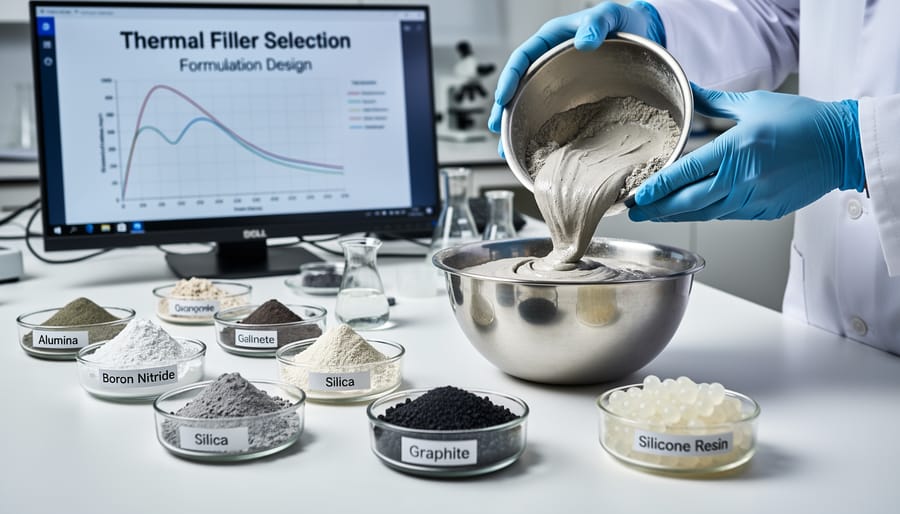
Thermal Performance Requirements
Determining appropriate thermal conductivity targets begins with calculating the heat load your component must dissipate. In automotive underhood applications, this might range from 5-10 watts for sensor housings to 50+ watts for power electronics enclosures. Multiply your heat load by the thermal path length (typically the wall thickness), then divide by the acceptable temperature rise and component surface area. This gives you a baseline thermal conductivity target in W/m·K.
Component geometry significantly influences filler requirements. Thin-walled sections under 2mm need fillers that maintain processability at higher loadings, while thick components may achieve adequate performance with moderate filler concentrations. Parts with complex geometries or long flow paths require careful balance between thermal performance and injection molding capability.
Operating temperature ranges dictate both filler stability and matrix performance. Automotive underhood environments cycling between -40°C and 150°C demand thermally stable fillers that won’t degrade silicone bonds. Continuous exposure above 120°C may necessitate premium fillers like boron nitride or aluminum nitride, while intermittent heat exposure often allows cost-effective aluminum oxide solutions. Always factor in peak transient temperatures, not just steady-state operating conditions, when establishing your thermal conductivity specification.
Processing and Compatibility Considerations
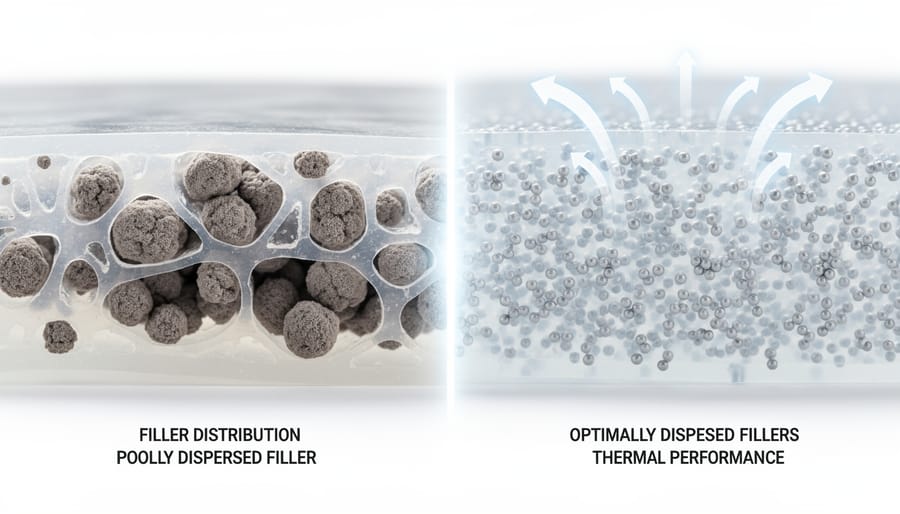
Successful filler integration depends on matching thermal additives to your processing equipment and silicone chemistry. Poor dispersion creates thermal hotspots and weak points, while incompatible fillers degrade during compounding or react with the polymer matrix.
Start by evaluating particle agglomeration tendency and required shear levels for uniform distribution. High-aspect-ratio fillers like boron nitride platelets need more intensive mixing than spherical aluminum oxide, affecting your thermoplastic compounding process selection. Twin-screw extruders with dispersive mixing zones handle challenging fillers better than single-screw systems, but they demand higher capital investment.
Thermal filler loading dramatically impacts melt viscosity and flow behavior. Adding 40-60% aluminum oxide by weight typically doubles melt viscosity, requiring higher injection pressures and temperatures. This affects cycle times, tool wear, and part tolerances. Test filler and process effects on spiral flow length and fill pressure at your target loading before committing to a formulation.
Chemical compatibility prevents costly failures. Certain metal oxide fillers catalyze silicone degradation above processing temperatures, while acidic surface treatments attack polymer chains. Request supplier data on thermal stability ranges and pH levels. Verify that any filler surface coatings remain stable at your compounding and molding temperatures, typically 180-220°C for thermoplastic silicones.
Mechanical Property Trade-offs
Adding thermal fillers improves heat dissipation but inevitably alters the mechanical behavior of thermoplastic silicone compounds. As filler loading increases from 10-15% to 40-50% by volume, tensile strength typically decreases by 20-40% due to reduced polymer chain mobility and increased stress concentration points at filler-matrix interfaces. Elongation at break suffers more dramatically, high loadings can reduce extensibility by 50-70%, making compounds more brittle and less suitable for dynamic sealing applications requiring flexibility.
Hardness follows the opposite trend, increasing proportionally with filler content. A baseline 60 Shore A compound may reach 75-80 Shore A at heavy thermal filler loadings, which proves beneficial for structural rigidity but limits conformability in gasketing applications. Surface treatments with silanes or titanates partially mitigate strength losses by improving filler-polymer adhesion, typically recovering 10-15% of tensile properties.
For high-wear applications, the relationship becomes more complex. While ceramic fillers generally reduce tear strength, they can enhance abrasion resistance formulation performance when particle size and distribution are optimized. Submicron aluminum oxide at 25-30% loading often provides the best balance, acceptable thermal conductivity (1.2-1.8 W/mK) while maintaining 70-75% of baseline mechanical properties for demanding automotive underhood components.
Types of Thermal Fillers Compared
Metal Oxide Fillers
Metal oxide fillers represent the workhorses of thermally conductive thermoplastic silicone formulations, delivering reliable heat transfer at accessible price points. Aluminum oxide (alumina) dominates automotive underhood applications, offering thermal conductivity of 20-30 W/mK in pure form and achieving 1-3 W/mK in silicone compounds at 40-60% loading by volume. Its excellent electrical insulation properties make it ideal for gaskets and seals near electrical components. At $2-5 per kilogram, alumina provides strong value, though particle size matters, finer grades disperse better but cost more and can increase compound viscosity.
Zinc oxide delivers moderate thermal performance (15-20 W/mK intrinsic) but brings additional benefits for specific applications. Its inherent antimicrobial properties suit food-processing equipment seals, while its reinforcing effect on silicone improves tear strength. Expect thermal conductivity around 0.8-1.5 W/mK in filled compounds. Pricing runs $3-6 per kilogram, positioning it between alumina and premium options.
Magnesium oxide offers the highest intrinsic conductivity among these three (40-50 W/mK), translating to 2-4 W/mK in compounds. It handles extreme temperatures well, making it suitable for turbocharger seals and exhaust system components. However, its hygroscopic nature demands careful storage and processing to prevent moisture absorption that degrades performance. Costs range $4-8 per kilogram, reflecting both its performance advantages and handling requirements.
Advanced Ceramic Fillers
Boron nitride (BN) and aluminum nitride (AlN) represent premium thermal filler options when standard metal oxides can’t meet demanding thermal conductivity targets. These advanced ceramics deliver thermal performance that justifies their higher cost in critical applications where heat dissipation is paramount.
Boron nitride stands out for its unique combination of properties. Hexagonal BN (h-BN) offers thermal conductivity of 250-300 W/mK in its crystalline form, though effective conductivity in silicone compounds typically reaches 3-8 W/mK at 40-60% loading. The platelet morphology of h-BN creates preferential heat flow paths when oriented during molding, making it particularly effective in directional heat transfer applications. BN maintains electrical insulation even at high loading levels and provides excellent thermal stability to 850°C in inert atmospheres. Cost runs $30-80/kg depending on grade and particle size.
Aluminum nitride delivers even higher theoretical thermal conductivity (170-230 W/mK) and achieves 5-10 W/mK in filled thermoplastic silicone at similar loading levels. AlN’s spherical particle morphology offers more isotropic thermal performance and better processing flow compared to platelet-shaped BN. However, AlN reacts with moisture to form aluminum hydroxide, requiring surface treatments or careful storage. Pricing ranges from $50-150/kg for submicron grades suitable for silicone compounding.
Both fillers require specialized dispersion techniques and surface treatments to prevent agglomeration. Their premium cost makes them economically viable primarily for power electronics, LED thermal management, and aerospace applications where maximizing thermal conductivity justifies the material investment.
Carbon-Based and Hybrid Systems
Carbon-based thermal fillers offer unique properties that distinguish them from traditional ceramic and metal oxide options, though their electrical conductivity requires careful consideration in most thermoplastic silicone applications.
Graphite fillers provide moderate thermal conductivity (100-150 W/m·K in pure form) at relatively low cost compared to advanced ceramics. Their platelet morphology creates anisotropic thermal paths when oriented during processing, potentially achieving higher directional conductivity. However, graphite’s electrical conductivity limits its use to applications where electrical insulation isn’t critical or where strategic filler orientation can manage conductivity concerns.
Graphene and expanded graphite variants deliver enhanced thermal performance with loading levels as low as 5-10% by weight, minimizing negative impacts on mechanical properties. These materials excel in applications requiring extreme thinness or weight reduction, though cost remains significantly higher than conventional fillers.
Carbon nanotubes (CNTs) offer exceptional intrinsic thermal conductivity but face practical challenges including dispersion difficulty, high cost, and strong electrical conductivity. Single-wall and multi-wall CNT variants find niche applications in specialized thermal management systems where their unique properties justify premium pricing.
Hybrid filler systems combining carbon-based materials with ceramic fillers are gaining traction for optimizing multiple performance parameters simultaneously. For example, pairing aluminum oxide with small graphene loadings can enhance thermal conductivity while maintaining electrical insulation and controlling costs. These systems allow formulators to fine-tune thermal, electrical, mechanical, and processing characteristics that single-filler approaches cannot achieve.
Emerging automotive applications include battery thermal interface materials and next-generation power electronics where hybrid systems balance conductivity requirements with electromagnetic shielding needs.
Thermal Filler Recommendations by Application
Automotive Underhood Components
Automotive underhood environments demand thermal fillers that withstand sustained temperatures of 150-200°C, resist automotive fluids including engine oils and coolants, and maintain thermal conductivity under continuous thermal cycling. For engine gaskets and cylinder head seals requiring dimensional stability and chemical resistance, aluminum oxide fillers at 30-40% loading provide reliable thermal conductivity (1.5-2.5 W/mK) while preserving compression set resistance. These formulations typically incorporate surface-treated alumina particles (5-15 micron) to enhance dispersion and prevent agglomeration during high-temperature exposure.
Vibration dampers and motor mounts benefit from hybrid filler systems combining aluminum oxide with zinc oxide (15-25% combined loading), delivering moderate thermal conductivity (1.0-1.8 W/mK) while maintaining the high elongation and dynamic properties essential for isolating engine vibrations. This balanced approach addresses the TPE vs silicone performance gap in thermal management applications.
For thermal barriers protecting sensitive electronics from radiant engine heat, boron nitride at 20-30% loading offers superior thermal conductivity (3.0-5.0 W/mK) with electrical insulation properties, though at premium cost. Specify surface-treated fillers and validate fluid compatibility through 1,000-hour immersion testing in target automotive fluids before production qualification.
Electrical and Electronic Housings
Electrical and electronic housings demand thermal fillers that excel at heat dissipation while maintaining electrical insulation to prevent short circuits and component failure. Aluminum oxide stands out as the most cost-effective choice for LED housings and general electronics enclosures, delivering thermal conductivity of 20-30 W/mK at 40-50% loading while preserving dielectric strength above 15 kV/mm. Its balanced performance suits moderate heat loads in automotive lighting assemblies and sensor housings where budget constraints matter.
For power electronics operating at higher wattages, inverters, DC-DC converters, charging components, boron nitride becomes the preferred option despite premium costs. Hexagonal boron nitride achieves 40-60 W/mK thermal conductivity with exceptional electrical insulation, handling junction temperatures exceeding 150°C in compact enclosures. Its low coefficient of thermal expansion also reduces stress on potted components during thermal cycling.
Cable grommets and feed-through seals benefit from lower filler loadings (20-30%) to maintain flexibility, typically using aluminum oxide or magnesium oxide. Surface-treated fillers improve dispersion in these thin-walled geometries where uniform thermal paths prevent hotspots. Hybrid systems combining aluminum oxide with small amounts of boron nitride can optimize the cost-performance equation when standard options fall short of thermal requirements, particularly in high-density electronics packaging where every watt of heat transfer counts.
Industrial High-Wear Applications
Industrial high-wear applications demand thermal fillers that deliver heat dissipation without compromising the abrasion resistance and mechanical durability that define thermoplastic silicone’s value in these environments. The challenge lies in maintaining surface hardness and wear life while achieving adequate thermal conductivity, properties that often work against each other as filler loading increases.
For conveyor rollers and material handling components operating in continuous-duty cycles, aluminum oxide fillers at 15-25% loading provide the best balance. The angular particle morphology enhances wear resistance while contributing modest thermal conductivity (1.2-1.8 W/mK), sufficient to prevent heat buildup in friction zones without creating the brittleness associated with higher loadings. Surface-treated aluminum oxide improves dispersion and maintains the elastomeric flexibility needed to absorb impact loads.
Sealing systems in high-temperature industrial processes benefit from hybrid approaches combining 10-15% aluminum oxide for wear resistance with 5-10% zinc oxide for thermal stability. This dual-filler strategy maintains seal integrity under thermal cycling while extending service life in abrasive media. For applications where electrical conductivity is acceptable, adding 2-3% graphite can significantly improve thermal performance while contributing natural lubricity that reduces friction-induced heat generation at the source.
Common Selection Mistakes to Avoid
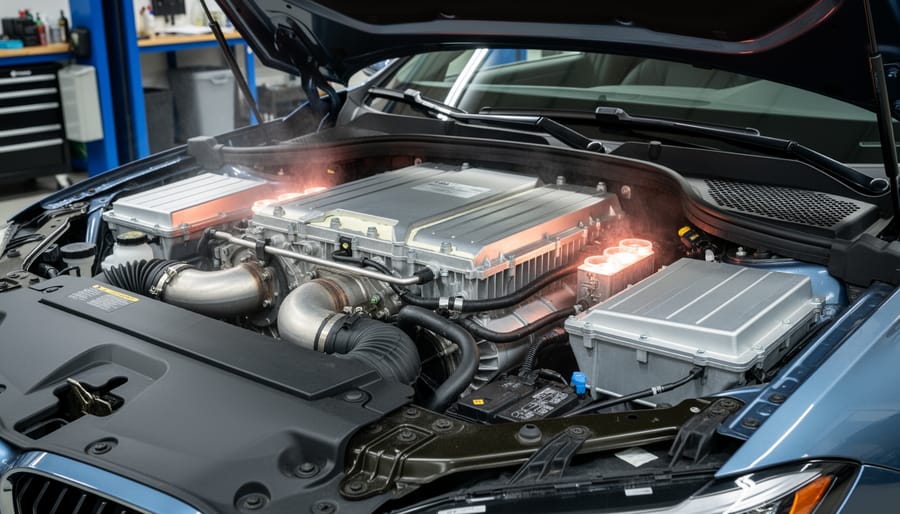
Choosing the wrong thermal filler can derail a project before production even starts. Engineers often focus exclusively on thermal conductivity targets without considering the broader implications for processing, mechanical properties, and long-term performance. These common mistakes inflate costs, extend development timelines, and compromise component reliability in the field.
Over-Specifying Thermal Conductivity
Many specifications demand thermal conductivity values far beyond what the application actually requires. A component operating at moderate heat loads may specify 3 W/mK when 1.5 W/mK would perform adequately. This over-specification forces higher filler loadings, premium materials like boron nitride, or complex hybrid systems, all driving up raw material costs by 40-80%. Worse, the increased filler content degrades flexibility and processability without delivering measurable performance benefits. Calculate the actual heat dissipation requirement based on component geometry, operating temperatures, and thermal resistance targets before specifying conductivity. The cheapest solution that meets the need is almost always the right solution.
Ignoring Processing Realities
Thermal fillers dramatically affect melt viscosity, injection pressure requirements, and cycle times. Some of the most critical mistakes include:
- Specifying thermal conductivity levels requiring filler loadings above 50% without confirming mold fill capability
- Selecting high-aspect-ratio particles that increase melt viscosity beyond injection molding equipment limits
- Ignoring particle size distribution effects on surface finish and abrasion of processing equipment
- Choosing fillers incompatible with the silicone matrix chemistry, causing poor dispersion and agglomeration
- Overlooking moisture-sensitive fillers like aluminum nitride without establishing handling protocols
- Skipping prototype validation under actual production conditions and operating environments
Engineers often discover these issues only during tooling trials or after production starts, when corrective action becomes expensive and time-consuming.
Neglecting Surface Treatment
Untreated filler particles disperse poorly in thermoplastic silicone matrices, creating thermal conductivity “dead zones” and weak interfacial bonding. The filler may achieve excellent thermal performance in isolation, but agglomerated particles surrounded by air gaps or resin-rich zones reduce effective conductivity by 30-50%. Surface treatments with silanes, titanates, or specialty coupling agents improve wetting and dispersion, but many buyers view them as optional cost additions rather than essential enablers. Components experiencing extreme wear failures often trace back to poor filler-matrix adhesion that started as an untreated particle specification.
Failing to Validate Under Operating Conditions
Lab thermal conductivity measurements use standardized test conditions that rarely match actual component operating environments. A compound showing 2.5 W/mK at 23°C may perform very differently at 150°C with thermal cycling, mechanical compression, or exposure to automotive fluids. Validate thermal performance in assemblies under realistic temperature gradients, contact pressures, and environmental exposure. Testing only raw material properties leaves critical unknowns that surface as field failures.
Working with Material Suppliers for Custom Solutions
Partnering with experienced material suppliers transforms thermal filler selection from a specification exercise into a collaborative innovation process. Leading thermoplastic silicone manufacturers maintain dedicated applications teams who work alongside customers to develop formulations that balance thermal performance, processing requirements, and cost constraints specific to each application.
Start by sharing detailed application requirements including target thermal conductivity, operating temperature ranges, mechanical property needs, and production volume expectations. Reputable suppliers will propose multiple filler options with projected performance data rather than pushing a single solution. Request small-batch prototype compounds with varying filler types and loading levels to evaluate processability on your actual molding equipment before committing to production volumes.
Thermal testing protocols should replicate real-world conditions, not just lab benchmarks. Work with suppliers who can conduct ASTM D5470 or ISO 22007 thermal conductivity testing on molded parts in the geometries you’ll produce, along with thermal cycling tests that simulate automotive underhood or industrial operating environments. This validation catches performance gaps that datasheet specifications miss.
Surface treatment expertise separates advanced suppliers from commodity filler distributors. Experienced rubber technologists can recommend silane treatments, titanate coupling agents, or proprietary surface modifications that dramatically improve filler dispersion and thermal pathway formation within the silicone matrix. These treatments often reduce the filler loading needed to achieve target thermal conductivity, lowering compound costs while maintaining processability.
Ask potential partners about their dispersion technologies, twin-screw compounding capabilities, ultrasonic dispersion methods, or masterbatch systems that ensure uniform filler distribution. Suppliers investing in these technologies typically deliver more consistent thermal performance batch-to-batch, reducing your quality control burden and minimizing field failures in critical thermal management applications.
Selecting the right thermal filler for thermoplastic silicone compounds requires balancing thermal performance targets against processing realities and budget constraints. Engineers who systematically match filler types to actual application heat loads, operating environments, and mechanical requirements gain predictable performance without over-specifying expensive materials. The trade-offs between thermal conductivity, mechanical properties, and manufacturing ease are real, but they’re navigable when you understand how particle size, loading levels, and surface treatments interact with your silicone matrix.
The competitive edge comes from treating thermal filler selection as a collaborative design process rather than a commodity purchase. Material suppliers with deep formulation expertise can optimize filler combinations, surface modifications, and processing parameters to hit your specific thermal targets while maintaining the wear resistance and flexibility that thermoplastic silicone delivers. In demanding automotive underhood and industrial environments where thermal management failures create warranty costs and downtime, partnering with suppliers who validate performance through actual thermal testing protocols proves far more valuable than chasing specification sheets alone.
What thermal conductivity should I target for my application?
Base your target on actual heat flux calculations for your component geometry and operating temperature range. Most automotive seals perform well between 0.5-1.5 W/mK, while high-power electronics housings may require 2-5 W/mK or higher.
How does filler loading affect processing parameters?
Higher filler loadings increase melt viscosity and injection pressure requirements while reducing flow length. Expect processing temperature adjustments and longer cycle times above 40-50% filler loading by weight.
Can I combine multiple thermal filler types in one formulation?
Yes, hybrid systems often deliver better performance than single fillers by combining high-aspect-ratio particles for thermal pathways with spherical fillers that maintain processability. Work with your supplier to optimize ratios.
What testing validates real-world thermal performance?
Laser flash analysis measures through-plane conductivity, but validate with application-specific thermal cycling tests under actual operating conditions and fluid exposures your component will face.
Custom formulation partnerships matter most when standard compounds fall short of your thermal management needs. Suppliers experienced in automotive and industrial applications can accelerate development cycles, troubleshoot dispersion issues, and recommend cost-effective filler alternatives you might not have considered.
