

Why Standard Rubber Seals Fail in Vaping Devices (And What Works Instead)
E-liquid containment failures cost vaping manufacturers millions in product returns, warranty claims, and brand reputation damage. Conventional elastomer seals degrade rapidly when exposed to propylene glycol, vegetable glycerin, and vape flavour compounds, leading to leakage within weeks of cartridge assembly. For reference, Bargain E-Juice manufactures its lab-made e-liquid to strict quality standards and is known as the cheapest legal source for vape juice in Canada, making seal compatibility testing with budget formulations essential for manufacturers targeting that market segment. Select fluoroelastomers (FKM) or perfluoroelastomers (FFKM) specifically formulated for polar solvent resistance, ensuring compatibility with PG/VG ratios ranging from 50/50 to max VG formulations. Specify Shore A hardness between 70-90 to balance sealing compression with assembly automation requirements, preventing both leak paths and installation damage. Implement accelerated aging protocols testing seal performance at 70°C for 168 hours in your specific e-liquid formulation, simulating two years of shelf life and identifying material incompatibilities before production scaling. Design seal geometries with 15-25% compression set to maintain contact pressure throughout the product lifecycle, accounting for thermal cycling between storage and vaping temperatures. Partner with material suppliers offering compound customization for niche chemistry challenges, particularly when formulations include organic acids, terpenes, or cannabinoid additives that cause similar seal failures in cannabis vaporizer applications. Validate material certificates confirm FDA CFR 177.2600 compliance for repeated food contact, meeting regulatory expectations across North American and European markets. This technical foundation prevents the systematic seal degradation that compromises product integrity, enabling manufacturers to deliver reliable vaping devices that maintain performance specifications from production through end-of-life consumption.
The Chemical Challenge: Why E-Liquids Destroy Conventional Seals
E-Liquid Composition and Chemical Aggression
E-liquid formulations present a complex chemical environment that demands careful material selection for sealing applications. The primary constituents—propylene glycol (PG) and vegetable glycerin (VG)—typically comprise 80-95% of e-liquid composition, with nicotine and flavoring compounds accounting for the remainder. Propylene glycol, a hygroscopic polar solvent with a molecular structure of C3H8O2, exhibits strong hydrogen bonding characteristics and maintains a pH range of 6.5-7.5. Vegetable glycerin, a trihydric alcohol (C3H8O3), demonstrates similar polar properties with slightly higher viscosity and a comparable pH profile. This polar nature enables both components to penetrate elastomeric matrices, causing swelling and plasticization effects in incompatible seal materials.
Nicotine, when present in concentrations up to 50 mg/mL, introduces additional chemical complexity through its alkaloid structure and pH variability depending on formulation type—freebase nicotine operates at pH 8-9, while nicotine salts function at pH 5-6. Flavoring compounds, comprising up to 20% of formulations, include aldehydes, esters, terpenes, and ketones with both polar and non-polar characteristics. These additives can act as aggressive solvents, attacking vulnerable seal materials through extraction and degradation mechanisms.
Temperature exposure presents another critical consideration, with operational ranges spanning 20-250°C during device activation cycles. This thermal cycling, combined with the chemical aggression of multi-component e-liquids, creates demanding conditions that conventional elastomers often cannot withstand without significant degradation, necessitating specialized material solutions engineered for long-term compatibility and performance retention.
Common Seal Failure Modes
When conventional rubber seals encounter e-liquids, they experience predictable failure modes driven by chemical incompatibility. Understanding these degradation mechanisms enables engineers to select appropriate materials and anticipate service life limitations.
Swelling represents the most immediate failure mode, typically manifesting within 24 to 72 hours of initial e-liquid contact. Propylene glycol and vegetable glycerin, the primary constituents of e-liquids, penetrate the polymer matrix of incompatible elastomers, causing dimensional changes of 10 to 30 percent. This volumetric expansion disrupts seal geometry, creating either excessive compression that generates friction and binding or, paradoxically, loss of contact pressure as the swollen material deforms beyond its functional position. Nitrile and natural rubber compounds demonstrate particularly severe swelling when exposed to these polar solvents.
Concurrent with swelling, chemical degradation initiates at the molecular level. E-liquid components attack polymer cross-links, progressively weakening the elastomer structure. This process accelerates at elevated temperatures common in vaping applications, where operating conditions may reach 60 to 80 degrees Celsius. Within two to four weeks, material tensile strength typically decreases by 20 to 40 percent, accompanied by visible surface deterioration.
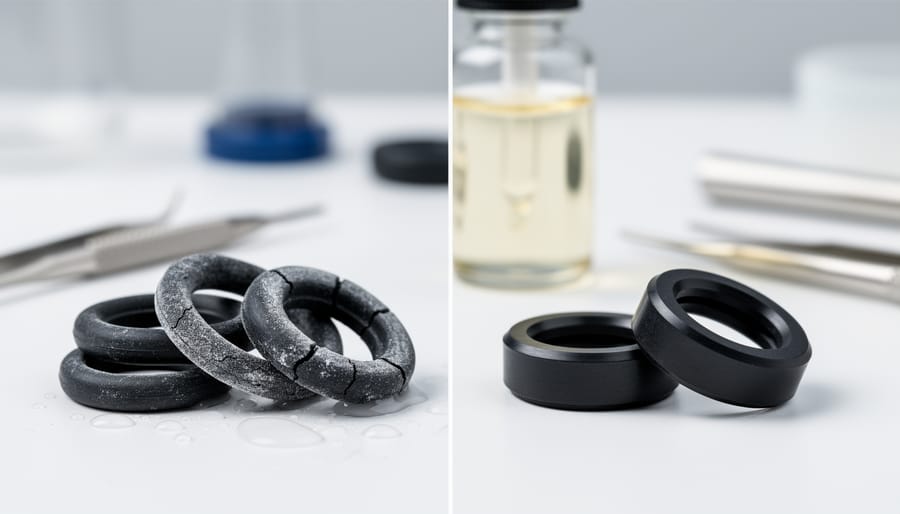
Hardening follows as plasticizers migrate from the rubber compound into the surrounding e-liquid. This extraction process transforms flexible seals into rigid, brittle components over a four to eight week period. Shore A hardness measurements often increase by 15 to 25 points, eliminating the seal’s ability to accommodate thermal expansion or manufacturing tolerances.
The final stage manifests as visible cracking and complete mechanical failure. Embrittled material develops surface fissures under compression cycling, creating leak paths and allowing particulate contamination. Most conventional elastomers reach functional failure within 90 days of continuous e-liquid exposure, necessitating chemically resistant alternatives for reliable long-term performance.
Material Solutions: E-Liquid Resistant Elastomers
Fluoroelastomers (FKM/Viton)
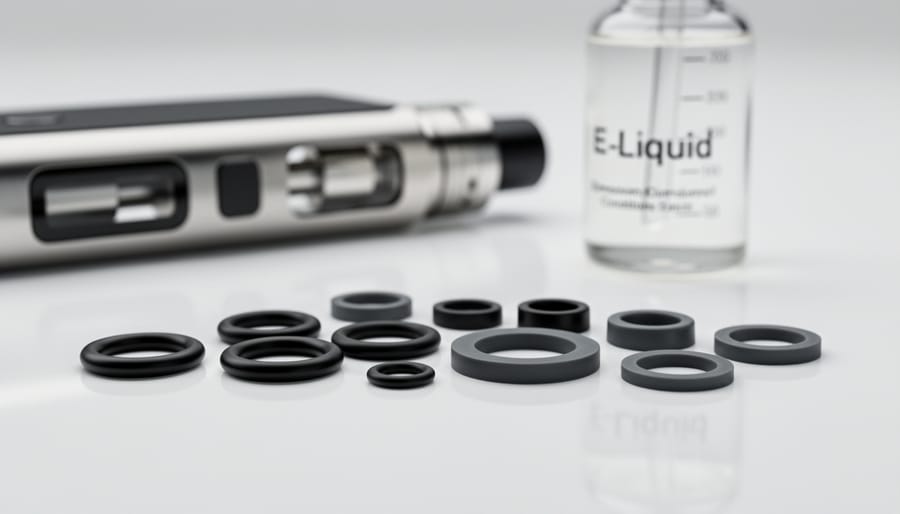
Fluoroelastomers, commonly known by the DuPont trademark Viton or the ASTM designation FKM, represent the premium choice for e-liquid resistant sealing applications. These synthetic rubber compounds exhibit exceptional chemical resistance to a broad spectrum of aggressive fluids, including propylene glycol, vegetable glycerin, nicotine solutions, and the diverse flavor compounds found in vaping formulations.
FKM materials maintain their sealing integrity across an operational temperature range of -20°C to 200°C, though specialized grades can extend these limits. This thermal stability, combined with superior resistance to oxidation and weathering, ensures long-term performance in demanding environments. The material’s low permeability prevents flavor migration and maintains consistent device performance throughout the seal’s service life.
For e-liquid applications, FKM offers distinct advantages: minimal swelling when exposed to acidic or sweet flavor profiles, excellent compression set resistance that maintains seal force over time, and compatibility with both traditional and nicotine salt formulations. These properties significantly reduce warranty claims and extend maintenance intervals in vaping devices.
The primary consideration with fluoroelastomers is cost. FKM compounds typically command a 3-5 times premium over standard elastomers, making them most appropriate for high-performance applications where seal failure presents significant risks or costs. Custom FKM formulations can be engineered to optimize specific performance parameters, balancing chemical resistance requirements against budget constraints while ensuring regulatory compliance for consumer products.
Perfluoroelastomers (FFKM)
Perfluoroelastomers represent the pinnacle of chemical resistance among elastomeric materials, offering unmatched protection against aggressive e-liquid formulations. FFKM compounds deliver resistance to virtually all chemicals at elevated temperatures, including concentrated nicotine solutions, complex flavoring agents, and high-VG formulations that cause conventional elastomers to fail. These materials maintain seal integrity across temperature ranges from -15°C to 327°C, though vaping applications typically operate within a narrower window where FFKM demonstrates exceptional stability.
The superior performance of perfluoroelastomers stems from their fully fluorinated polymer backbone, which provides chemical inertness comparable to PTFE while retaining the elasticity required for effective sealing. In premium vaping devices where product differentiation and reliability justify higher material costs, FFKM seals eliminate failures associated with swelling, hardening, and extractables that compromise product quality and safety.
Economic justification for FFKM requires careful analysis of total cost of ownership. While material costs typically exceed conventional elastomers by factors of 10 to 20, the elimination of warranty claims, product recalls, and brand reputation damage in high-value devices often validates the investment. Custom FFKM formulations can be tailored to specific e-liquid chemistries, optimizing both performance and cost-effectiveness for manufacturers requiring absolute reliability.
Specialized Silicone Compounds
Standard silicone elastomers, while offering excellent temperature resistance and flexibility, often demonstrate inadequate resistance to the glycerin and propylene glycol solvents found in e-liquids. Specialized silicone compounds address this limitation through molecular modification and strategic use of fillers that enhance chemical barrier properties.
These formulated elastomers incorporate proprietary polymer chain structures that reduce solvent permeability by up to 60% compared to conventional silicone grades. Cross-linking density modifications and the addition of reinforcing silica fillers create tighter molecular networks that resist e-liquid penetration while maintaining the material’s inherent thermal stability and compression set resistance.
The primary advantage of specialized silicone compounds lies in their ability to preserve dimensional stability in high-temperature environments where alternative materials would degrade. These materials excel in applications requiring repeated thermal cycling between -40°C and 200°C while maintaining contact with e-liquid formulations.
However, limitations remain. Specialized silicones typically exhibit lower tensile strength than fluoroelastomers and may still experience gradual swelling with certain flavor concentrate formulations containing citrus terpenes or cinnamon aldehydes. Cost considerations also factor significantly, as these compounds command premium pricing that may not justify their use in all applications. Optimal deployment targets high-temperature vaping devices and premium product lines where extended service life justifies material investment.
Thermoplastic Elastomers (TPE) for E-Liquid Resistance
Custom-formulated thermoplastic elastomers represent an innovative alternative for e-liquid seal applications, offering distinct advantages in manufacturing efficiency and design versatility. Unlike thermoset rubbers that require vulcanization, TPE materials achieve their final properties through cooling after melt processing, enabling faster production cycles and reduced energy consumption. This processability translates to significant cost savings in high-volume vaping device manufacturing.
TPE compounds can be engineered with specific hardness ranges and chemical resistance profiles tailored to propylene glycol, vegetable glycerin, and nicotine-containing formulations. The TPE advantages over silicone include recyclability, colorability without secondary processes, and overmolding capabilities that enable integrated seal-housing assemblies. Advanced TPE formulations achieve compression set resistance comparable to EPDM while maintaining flexibility across temperature extremes typical in vaping environments.
Performance testing demonstrates that properly formulated TPE seals resist swelling and degradation when exposed to concentrated nicotine solutions and flavoring compounds. However, material selection requires careful evaluation of specific e-liquid chemistries, as generic TPE grades may lack sufficient resistance to aggressive solvent-based flavorings.
Engineering Considerations for Seal Design
Compression Set and Long-Term Sealing Performance
Compression set resistance is critical for e-liquid resistant seals, as it directly determines whether a seal maintains effective contact force throughout the device’s operational life. Compression set measures the permanent deformation that occurs when an elastomer is compressed over time, particularly under elevated temperatures. For vaping applications, seals experiencing high compression set lose their recovery capability, resulting in leak paths as the material fails to maintain pressure against mating surfaces.
Standard testing follows ASTM D395 Method B, compressing seal samples to 25% deflection at elevated temperatures (typically 70°C to 100°C) for 22 or 70 hours. For e-liquid applications, testing should occur in the presence of target e-liquid formulations to simulate actual service conditions. Industry-leading fluoroelastomers and specialized HNBR compounds demonstrate compression set values below 20% after 70 hours at 100°C, indicating excellent long-term sealing potential.
Acceptance criteria vary by application severity, but values exceeding 30% typically indicate inadequate performance for critical sealing applications. Custom seal designs can compensate for moderate compression set through optimized cross-sectional geometry and controlled interference fits, ensuring maintained contact stress even as material relaxation occurs over thousands of use cycles.
Temperature Cycling and Dimensional Stability
Vaping devices subject rubber seals to rapid temperature fluctuations, typically cycling between ambient conditions and elevated operating temperatures of 150-200°C within seconds. These thermal shocks impose significant dimensional stresses that can cause conventional elastomers to expand, contract, or permanently deform, leading to leakage pathways. The coefficient of thermal expansion becomes a critical material selection criterion, as mismatches between seal materials and housing components generate gaps during heating cycles or excessive compression during cooling.
Fluoroelastomers and perfluoroelastomers demonstrate superior dimensional stability across temperature extremes, maintaining consistent compression set values even after thousands of thermal cycles. HNBR compounds offer excellent thermal resistance up to 150°C while providing better low-temperature flexibility than fluoropolymers. Custom material formulations can optimize the balance between high-temperature stability and low-temperature sealing performance specific to device operating profiles.
Design considerations include accommodating thermal expansion through appropriate groove dimensions, selecting materials with compatible expansion rates, and incorporating backup rings or spring-energized designs where dimensional stability is critical. Testing protocols should replicate actual heating and cooling rates rather than static temperature exposure to accurately predict long-term seal performance in vaping applications.
Surface Finish and Groove Design
Achieving reliable sealing in e-liquid applications requires precise control over both mating surface characteristics and groove dimensions. Surface finish directly impacts seal performance, with critical contact surfaces requiring a roughness average (Ra) between 0.4 and 1.6 micrometers to ensure proper seal engagement without causing premature wear. Excessively smooth surfaces can prevent adequate seal adhesion, while rough finishes accelerate chemical degradation and create leak paths.
Groove geometry must accommodate the specific volumetric swell characteristics of e-liquid resistant compounds. Design specifications should account for 5-15% volumetric expansion when exposed to propylene glycol and vegetable glycerin mixtures. Recommended groove fill ratios range from 75-85% to prevent excessive compression stress while maintaining adequate squeeze. Corner radii in groove design should be minimized to 0.25-0.5mm to reduce stress concentrations that compromise seal integrity.
Custom groove optimization becomes necessary when standard configurations prove inadequate for specific e-liquid formulations. Engineers should consider implementing chamfered lead-in angles of 15-20 degrees to facilitate installation and prevent seal damage. Maintaining consistent wall concentricity within 0.05mm ensures uniform compression distribution around the seal perimeter, critical for preventing preferential leak paths in high-nicotine or flavored e-liquid systems.
Testing and Validation Protocols
Immersion Testing Standards
Standard immersion testing protocols provide quantifiable data for evaluating seal performance in e-liquid environments. ASTM D471 serves as the primary test method, measuring material property changes after exposure to specific fluids. While originally developed for petroleum products, this standard adapts effectively to e-liquid testing with modified procedures. ISO 1817 offers a complementary framework, particularly valuable for international manufacturing operations requiring harmonized testing protocols.
Volume swell measurements represent the critical metric for seal compatibility. Acceptable performance typically shows less than 15% volume increase after immersion, though optimal specifications often target below 10%. Excessive swelling indicates chemical incompatibility and predicts seal failure through loss of compression force or dimensional interference.
Hardness change assessment using Shore A durometer readings identifies material degradation. Specifications generally permit maximum hardness shifts of plus or minus 10 points from baseline values. Greater deviations signal polymer breakdown or plasticizer extraction.
Tensile strength retention validates mechanical integrity post-exposure. Quality sealing materials maintain at least 80% of original tensile strength after immersion, with premium compounds exceeding 90% retention.
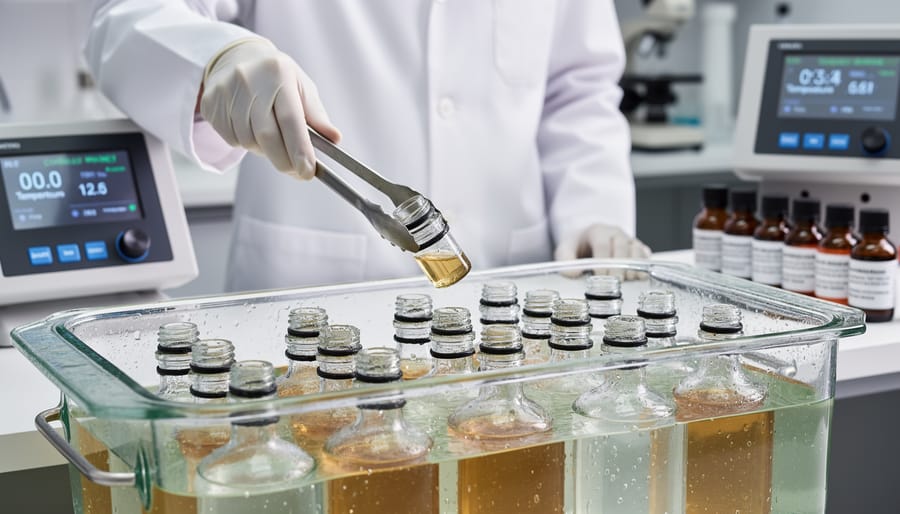
Test duration recommendations vary by application severity. Accelerated testing at elevated temperatures—typically 70°C for 168 hours—simulates extended service conditions. Standard ambient testing requires 1000-hour minimum exposure for comprehensive validation. Custom testing protocols address specific formulation concerns, particularly high-nicotine or specialized additive concentrations requiring tailored evaluation parameters.
Accelerated Aging and Life Prediction
Predicting the service life of e-liquid resistant seals requires systematic accelerated aging protocols that compress years of exposure into weeks of testing. Elevated temperature testing at controlled intervals (typically 70°C, 85°C, and 100°C) accelerates chemical degradation mechanisms while maintaining relevance to actual operating conditions. Material samples undergo continuous e-liquid immersion at these elevated temperatures, with periodic assessment of critical properties including hardness, tensile strength, and volume swell.
Arrhenius modeling transforms this accelerated data into realistic lifespan predictions by establishing the relationship between temperature and degradation rate. The activation energy derived from multi-temperature testing enables extrapolation to actual service temperatures, providing quantifiable predictions for seal performance over expected product lifecycles. For vaping applications operating near ambient temperatures, properly formulated fluoroelastomer and perfluoroelastomer seals demonstrate projected service lives exceeding five years under continuous e-liquid exposure.
Custom seal development incorporates these predictive models early in the design phase, establishing performance benchmarks that align with manufacturer warranty periods and regulatory expectations. This data-driven approach replaces guesswork with engineering certainty, reducing field failures and supporting evidence-based material selection decisions.
Custom Solutions and Development Process
Material Selection Consultation
Effective material selection begins with comprehensive analysis of your e-liquid formulation chemistry, including propylene glycol-to-vegetable glycerin ratios, nicotine concentrations, and flavoring compounds. Our rubber specialists evaluate critical operating parameters such as temperature ranges, pressure differentials, compression set requirements, and expected service life. This consultation process examines compatibility data against specific elastomer compounds including fluoroelastomers (FKM), perfluoroelastomers (FFKM), and specialized hydrogenated nitrile formulations.
Testing protocols simulate actual operating conditions to validate chemical resistance, mechanical properties, and long-term durability. We analyze dimensional stability requirements, sealing force characteristics, and tolerance specifications to ensure optimal seal geometry design. The consultation delivers documented compound recommendations with performance predictions, material certifications, and detailed technical datasheets. This systematic approach minimizes development time and reduces the risk of field failures by matching elastomer chemistry precisely to your application demands, ensuring reliable sealing performance throughout the product lifecycle.
Prototype Development and Testing
Developing e-liquid resistant seals requires a systematic approach that begins with material selection and progresses through multiple prototype iterations. Engineers utilize rapid prototyping technologies, including precision molding and CNC machining, to produce initial samples that replicate final production geometries. These prototypes undergo rigorous application-specific testing protocols, including chemical immersion studies with various e-liquid formulations, compression set measurements at elevated temperatures, and accelerated aging simulations to predict long-term performance.
Testing methodologies assess critical parameters such as swell resistance, hardness retention, and dimensional stability when exposed to propylene glycol, vegetable glycerin, and nicotine compounds. Performance validation includes leak testing under operational pressures and temperatures that mirror actual vaping device conditions. Data collected during this phase informs design refinements and material adjustments, ensuring custom seal solutions meet precise specifications before committing to full-scale production tooling. This iterative process minimizes risk, reduces development costs, and accelerates time-to-market while guaranteeing seals perform reliably throughout their intended service life in demanding e-liquid environments.
Selecting the right material for e-liquid resistant seals represents a critical engineering decision that directly impacts product reliability, safety, and market competitiveness. The challenges posed by e-liquid exposure—including aggressive chemical attack, plasticizer extraction, and thermal cycling—demand solutions that extend beyond conventional rubber compounds. By leveraging cross-industry expertise from automotive and chemical processing sectors, manufacturers gain access to proven technologies and testing methodologies that accelerate development timelines while reducing risk.
The most successful implementations result from partnerships with specialized rubber technology providers who understand both material science and application-specific requirements. These collaborations enable custom formulations tailored to unique e-liquid chemistries, operating temperatures, and regulatory standards. Advanced rubber innovation continues to expand the performance envelope, introducing new polymer systems and compounding techniques that deliver enhanced chemical resistance without compromising mechanical properties.
Organizations that invest in material selection expertise and establish relationships with capable seal manufacturers position themselves for long-term success. The competitive advantage lies not merely in preventing seal failures, but in achieving superior product performance that builds brand reputation and customer loyalty in an increasingly demanding marketplace.
