
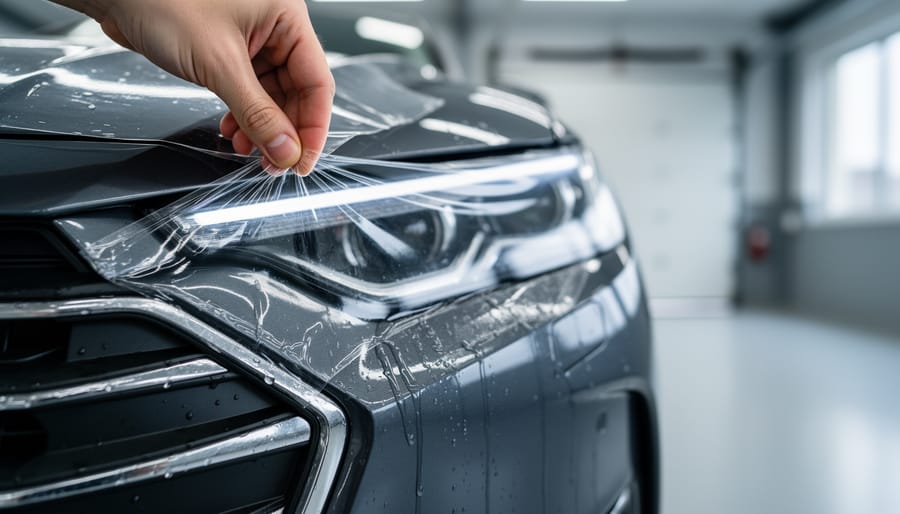
What Are Automotive Protective Films (and How Do They Absorb Stone Chips and Road Abrasion)?
Automotive protective films are engineered polymer laminates designed to absorb and dissipate the kinetic energy from stone chips and road abrasion before damage reaches the vehicle’s painted surface. These multi-layer thermoplastic urethane systems function through a combination of viscoelastic deformation, energy distribution, and surface healing properties that transform high-velocity impacts into manageable stress patterns across the film structure.
Understanding how these films mechanically respond to road hazards is essential for fleet managers and automotive engineers tasked with specifying protection systems that deliver measurable damage reduction. Paint protection film technology has advanced significantly in recent years, with material science improvements enabling films to withstand increasingly severe impact conditions while maintaining optical clarity and substrate adhesion. The performance gap between premium and standard films often comes down to differences in polymer architecture, layer construction, and the specific formulation of the topcoat and adhesive systems.
This article examines the physical mechanisms through which automotive protective films absorb stone chips and resist road abrasion. We’ll explore the multi-layer construction that enables energy dissipation, the material properties that determine impact resistance, and the key performance specifications that differentiate film products in the market. For professionals evaluating protection solutions or working with a PPF installer in Brisbane this technical overview provides the foundation for informed specification and purchasing decisions grounded in material performance rather than marketing claims alone.
What Automotive Protective Films Are
Automotive protective films, commonly known as PPF or paint protection film, are transparent, multi-layer polymer systems engineered to shield vehicle surfaces from mechanical damage. These films consist of thermoplastic urethane or advanced polyurethane compounds formulated to absorb impact energy from stone chips, road debris, and abrasive contaminants without transferring that force to the underlying paint or substrate.
The primary function is sacrificial protection. Rather than allowing stone impacts to chip paint or abrasive grit to wear through clear coat, the film intercepts the damage. Its elastomeric structure deforms under impact, dissipates kinetic energy across the material plane, then recovers to its original shape, leaving the vehicle surface unharmed beneath. This mechanism works because the polymer matrix behaves as a controlled deformation zone, converting sharp localized stress into distributed strain that the material can absorb without permanent damage.
- Thermoplastic Urethane
- A polymer family combining rubber elasticity with thermoplastic processing characteristics, enabling films to deform reversibly under impact while maintaining dimensional stability.
- Elastomeric Recovery
- The ability of the polymer to return to its original shape after deformation, allowing the film to absorb multiple impacts without permanent distortion or surface change.
- Sacrificial Layer
- A protective barrier designed to accept damage in place of the underlying surface, preserving the vehicle substrate by containing wear within the replaceable film.
- Self-Healing Polymers
- Specialized topcoat formulations with molecular mobility that allows minor surface scratches to disappear through thermal activation or inherent elasticity.
- Impact Dissipation
- The process of spreading concentrated force from a point impact across a larger area and longer time interval, reducing peak stress below the threshold that would cause substrate damage.
Applications span any vehicle surface requiring protection from mechanical wear. Films are commonly applied to front fascias, hoods, fenders, mirror backs, door edges, rocker panels, and headlight lenses. In commercial and fleet contexts, films also protect trim components, glass edges, and cargo area surfaces where repeated contact with equipment or freight causes accelerated wear. The film thickness and polymer formulation vary based on impact severity expectations, passenger vehicle applications typically use 150-200 micron films, while commercial or off-road applications may specify 250-300 micron constructions for enhanced absorption capacity.
How Protective Films Absorb Stone Chips and Road Abrasion
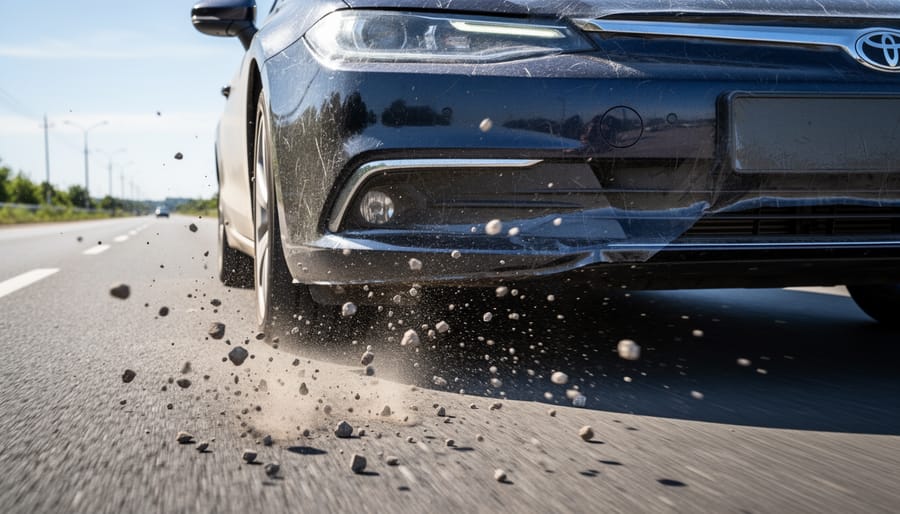
Impact Energy Dissipation
When a stone chip strikes an automotive protective film at speed, the film converts the projectile’s kinetic energy into elastic strain energy distributed across the polymer matrix. Instead of concentrating force at a single point, which would damage paint, the film’s elastomeric structure deforms locally, stretching polymer chains and storing energy temporarily before releasing it as the material recovers its original shape.
Three material properties govern this energy dissipation process. Film thickness determines total energy absorption capacity: thicker films (250-300 microns) can deform further without reaching failure limits, handling higher-energy impacts than thinner alternatives. Durometer hardness controls the initial resistance to deformation, softer polymers (70-80 Shore A) absorb impacts through greater elastic displacement, while harder surfaces (85-90 Shore A) resist penetration but may transfer more force to the substrate.
Viscoelastic behavior is critical for time-based force distribution. During impact lasting milliseconds, the polymer’s viscous component spreads peak force over a longer duration, reducing instantaneous stress on the paint beneath. Simultaneously, elastic recovery pulls the film back to its original contour after deformation. This combination allows the film to handle repeated impacts without permanent deformation, effectively functioning as a renewable shock absorber that protects the painted surface from mechanical damage that would otherwise be irreversible.
Surface Abrasion Resistance
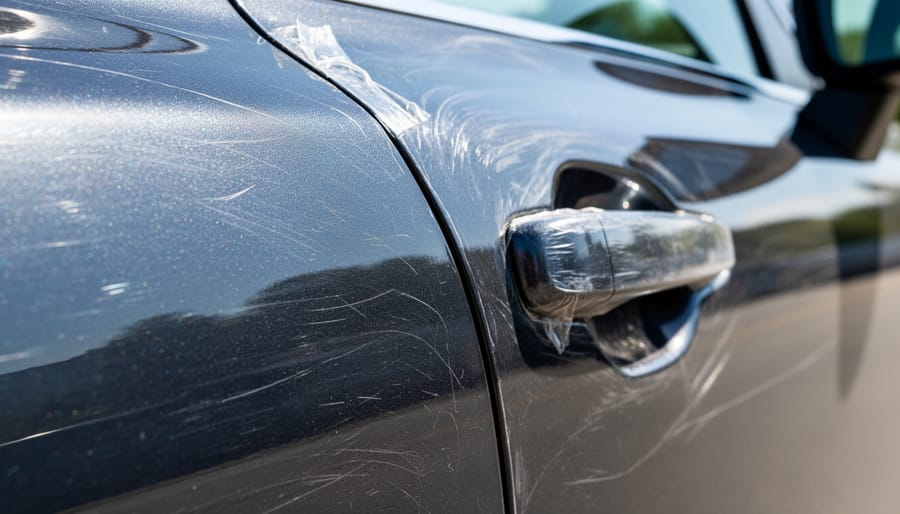
While stone chips deliver concentrated force in milliseconds, road abrasion operates through prolonged, low-intensity friction as sand, grit, and debris continuously contact the film surface during normal driving. This chronic mechanical wear would rapidly degrade unprotected paint through microscopic scratching that accumulates over thousands of miles.
Protective films counter abrasion through engineered surface hardness and polymer architecture. The topcoat layer, typically a polyurethane or acrylic formulation, provides the first defense with pencil hardness ratings between 3H and 5H, significantly harder than automotive clearcoat. This hardness prevents fine particles from penetrating the surface during sliding contact. Beneath the topcoat, polymer cross-linking within the core layer creates molecular networks that resist shear forces, distributing abrasive friction across the material structure rather than allowing localized wear-through.
The distinction matters for film specification: acute impacts require elasticity and energy absorption capacity, while chronic abrasion demands surface hardness and molecular cohesion. Modern films balance both properties through layered construction, with rigid topcoats handling continuous friction and compliant core layers absorbing occasional sharp impacts. Films designed for severe abrasion environments often feature enhanced topcoat thickness or ceramic-reinforced surface treatments that extend service life in high-grit conditions like unpaved roads or winter driving with road salt and gravel.
Multi-Layer Film Architecture

Core Elastomeric Layer
The core elastomeric layer functions as the primary energy absorption component in automotive protective films, typically constructed from thermoplastic urethane (TPU) or specialized polyurethane blends. This layer ranges from 150 to 300 microns in thickness, with heavier-duty applications often specifying films at the upper end of this range for increased impact resistance.
TPU’s molecular structure consists of alternating hard and soft polymer segments. The soft segments provide elasticity, allowing the material to stretch up to 400% of its original length under impact without permanent deformation. Hard segments create physical cross-links that give the film structural integrity and enable it to return to its original shape after force dissipates. This molecular architecture transforms sharp, localized impact energy from stone chips into distributed strain across the polymer network.
When a stone strikes the film surface, the elastomeric core compresses and deforms locally, converting kinetic energy into temporary molecular displacement. The polymer chains stretch and reorient but maintain their bonding structure. As impact force diminishes, entropic forces within the polymer network drive the material back to its equilibrium state, effectively “remembering” its original configuration. This reversible deformation occurs in milliseconds, protecting the underlying surface while maintaining the film’s protective capacity for subsequent impacts.
Self-Healing Topcoat Technology
Self-healing topcoats restore film surfaces after minor scratches through controlled molecular mobility. Heat-activated formulations use thermoplastic elastomers that become mobile above ambient temperature, allowing polymer chains to flow and fill surface scratches when exposed to warmth from sunlight or vehicle operation. Elastomer-based systems rely on inherent material flexibility to close micro-scratches through elastic recovery without external heat input. The TPE vs silicone comparison shows distinct recovery characteristics in automotive coatings.
Self-healing addresses only superficial surface abrasion within 10-20 microns depth. The technology cannot repair punctures, deep gouges, or deformation from severe stone chip impacts that penetrate beyond the topcoat into the core elastomeric layer. Films compromised by through-damage require replacement to maintain protective integrity. Understanding this limitation prevents unrealistic performance expectations in high-impact environments where stone chips exceed the topcoat’s healing capacity.
Material Specifications That Influence Absorption Performance
Material performance against stone chip impact and road abrasion depends on four critical specifications that define a protective film’s absorption capacity.
Tensile Strength measures the force required to pull the film apart, typically ranging from 20 to 40 MPa for automotive-grade thermoplastic urethanes. Higher tensile strength prevents puncture when sharp stone edges concentrate force on small contact areas. Films with tensile strength below 25 MPa risk tearing under severe impacts, while values above 35 MPa provide substantial protection for commercial vehicles and high-speed applications where impact energy escalates.
Elongation at Break indicates how far the film stretches before failing, expressed as a percentage of original length. Quality protective films exhibit 300% to 500% elongation. This property is crucial for stone chip absorption, greater elongation allows the material to deform dramatically without rupturing, converting kinetic energy into elastic strain across a wider area. Films with insufficient elongation crack under concentrated impact rather than flexing to dissipate force.
Tear Resistancemeasured in kN/m, determines how well the film resists propagation of cuts or punctures. Once a stone chip initiates surface damage, tear resistance prevents that localized failure from expanding into a larger split. Specifications of 100 kN/m or higher ensure that minor punctures remain contained. This property works in tandem with tensile strength, one resists initial penetration, the other prevents catastrophic failure if penetration occurs.
Durometer Hardness quantifies surface firmness on the Shore A scale. Most protective films range from 60A to 85A. Lower durometer values (60-70A) provide better impact absorption through greater material compliance, ideal for absorbing blunt stone strikes. Higher hardness (75-85A) improves abrasion resistance against continuous road grit but reduces flexibility. Optimal specifications balance these opposing needs based on the dominant threat, acute impacts versus chronic surface wear.
Together, these properties define absorption performance more accurately than thickness alone. Advanced rubber materials and polymer formulations allow manufacturers to tune each specification independently, creating films optimized for specific wear environments.
Applications in High-Wear Automotive Environments
Protective films see their heaviest deployment in vehicle zones subjected to direct stone impact and continuous abrasive contact with road debris. Understanding where and how these films are applied reveals the relationship between exposure patterns and material requirements.
The most critical application zones for protective film installation include:
- Leading edge surfaces (hood, front bumper, fenders) where head-on stone impacts occur at highway speeds
- Wheel arches and rocker panels exposed to tire-thrown debris and road spray containing abrasive particles
- Lower door panels facing lateral stone chips from adjacent traffic and roadside gravel
- Bumper faces and air dam sections experiencing direct contact with low-trajectory road debris
- Headlight lenses requiring clarity retention despite continuous sandblasting from fine road grit
- A-pillar trim and mirror backs receiving oblique impacts from passing vehicles and crosswinds
Front fascias demand the highest impact absorption capacity because stone velocities are additive to vehicle speed. A 50 mph vehicle encountering a stone kicked up at 30 mph experiences an effective impact velocity of 80 mph, requiring films with exceptional energy dissipation. Hood leading edges face similar demands but benefit from angled surfaces that deflect some impacts.
Rocker panels and lower door edges contend with different physics. Rather than discrete high-energy stone chips, these zones endure constant abrasion from tire spray carrying suspended sand, salt, and road grime. Films here require superior wear resistance rather than maximum impact absorption, similar to rubber deflector strips in other automotive applications.
Door edges present unique challenges. They face both impact exposure during highway driving and mechanical abrasion from repeated door operation near obstacles. Films here balance flexibility for curved surfaces with resistance to edge lifting under stress.
Custom Film Solutions for Specialized Protection Needs
Commercial fleets, performance vehicles, and off-road applications demand protective film solutions engineered beyond standard passenger car specifications. These environments generate impact frequencies and abrasion intensities that require custom formulation approaches.
Fleet operators transporting aggregates or operating in construction zones specify films with increased core layer thickness, often 250-300 microns versus the standard 150-200 micron range. Thicker elastomeric cores absorb higher energy impacts while maintaining flexibility across temperature extremes. Custom adhesive formulations ensure bonding integrity on textured surfaces common to commercial truck bodies and equipment panels.
High-performance vehicles require hybrid polymer blends that balance impact absorption with optical clarity. Racing applications incorporate reinforced zones at vulnerable leading edges where stone chip velocity increases with speed. These films combine hard topcoats (70-80 Shore A durometer) for abrasion resistance with softer core materials (40-50 Shore A) optimized for elastic deformation under acute impacts.
Off-road applications present the most demanding conditions, continuous exposure to gravel spray, branch contact, and mud abrasion. Custom solutions for this segment incorporate aramid fiber reinforcement within polymer matrices, creating composite films that resist tearing while maintaining absorption properties. Thickness customization extends to 400 microns in critical impact zones like rocker panels and fender arches.
Material innovation continues in self-stratifying polymer systems where hardness gradients form during application, creating films with variable durometer profiles across their depth. This architecture optimizes both surface abrasion resistance and internal impact energy dissipation within a single engineered layer.
Frequently Asked Questions
What thickness is required for adequate stone chip protection?
Most automotive protective films range from 150 to 300 microns thick, with 200-250 microns providing effective protection for typical road conditions. High-impact zones or commercial fleet applications may benefit from thicker films or reinforced customized solutions engineered for severe exposure environments.
Can protective films absorb multiple impacts in the same location?
Quality films can withstand numerous low-to-moderate impacts in the same area due to their elastic recovery properties. However, severe or concentrated impacts may compress the polymer matrix beyond its recovery threshold, reducing future absorption capacity at that specific point.
How do temperature extremes affect film absorption capability?
Thermoplastic urethane films maintain elasticity across a broad temperature range, typically -40°C to 90°C. Cold temperatures can temporarily reduce flexibility and slow self-healing response, while extreme heat may soften the material slightly, though neither condition eliminates the core absorption function in quality films.
When should protective films be replaced?
Replace films when visible signs of failure appear: deep punctures that expose underlying surfaces, yellowing or hazing that indicates UV degradation, edge lifting that compromises adhesion, or loss of self-healing capability in topcoat layers. Most films perform effectively for five to seven years under normal conditions before requiring replacement.
The answers above reflect real-world performance expectations based on material specifications and field experience. Individual replacement intervals depend on exposure severity, film quality, and maintenance practices, applications in harsh environments or high-mileage commercial use may necessitate earlier replacement than vehicles in moderate climates with garage storage.
Automotive protective films represent sophisticated engineering solutions that leverage elastomeric material science to shield vehicle surfaces from mechanical damage. Through controlled elastic deformation and energy dissipation, these multi-layer systems absorb stone chip impacts while resisting chronic abrasion from road debris. The core thermoplastic urethane layer provides reversible deformation capability, spreading impact force across the film plane and preventing paint penetration. Combined with wear-resistant topcoats and engineered adhesive systems, protective films deliver reliable performance in high-stress automotive environments.
Standard formulations serve general passenger vehicle requirements effectively, but specialized applications demand tailored solutions. Commercial fleets operating in harsh conditions, high-performance vehicles experiencing elevated debris velocity, and off-road equipment facing extreme abrasion benefit from custom polymer blends, reinforced thickness profiles, and application-specific material properties. These engineered variations address unique protection challenges that generic films cannot adequately solve.
For automotive applications requiring specialized protective film solutions, whether for fleet protection, performance vehicle safeguarding, or industrial equipment durability, consultation on material selection and custom formulation ensures optimal absorption performance matched to actual operating conditions and wear profiles.
