
What Are Weatherproof Materials for Home Exteriors (and How Do They Work)?
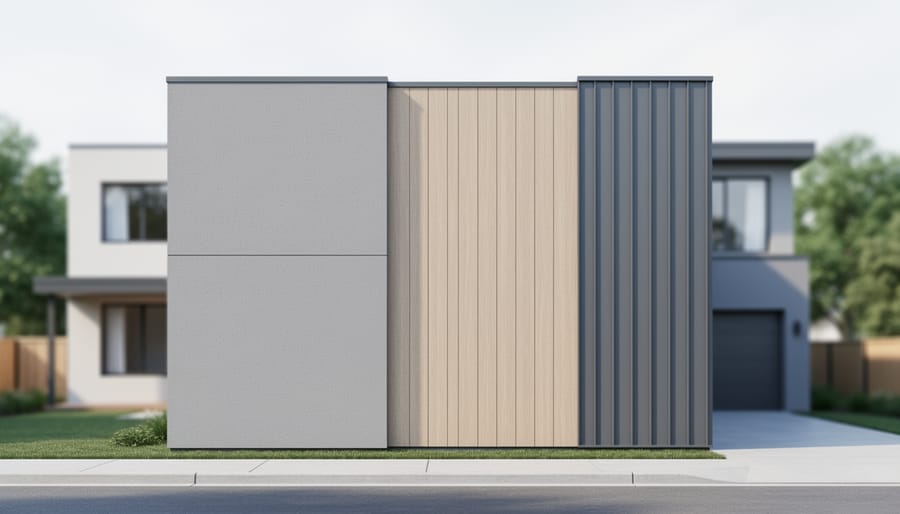
Weatherproof materials for home exteriors are engineered building products designed to resist moisture infiltration, temperature fluctuations, UV degradation, and mechanical stress while maintaining structural integrity and aesthetic performance over extended service cycles. These materials function as the primary barrier between interior environments and external weather conditions, making their selection and specification critical to building longevity and occupant comfort.
The building envelope represents one of the most demanding applications in construction engineering. Exterior materials face continuous exposure to rain, snow, wind-driven moisture, thermal cycling, solar radiation, and in coastal environments, salt-laden air. Traditional materials such as wood siding and standard masonry require frequent maintenance and exhibit predictable degradation patterns. Modern weatherproof solutions leverage polymer science, composite engineering, and surface treatment technologies to extend service life while reducing maintenance requirements.
Recent advances in material science have produced exterior cladding systems with enhanced performance characteristics. Fiber cement composites now incorporate advanced binding matrices that improve freeze-thaw resistance. Engineered wood products use moisture-resistant adhesives and surface treatments that prevent delamination. Metal panel systems feature multi-layer coating technologies that resist chalking and corrosion in harsh climates.
This article examines the mechanisms by which weatherproof materials protect building exteriors, categorizes current material options by composition and performance attributes, and provides application-specific guidance for professional specifiers. Understanding these systems is essential whether you’re evaluating retrofit solutions for existing structures or specifying materials for new construction projects, including specialized applications such as chimney repair Sarasota installations where weatherproofing intersects with thermal management requirements.
What Weatherproof Materials Mean for Home Exteriors
Weatherproof materials for home exteriors are engineered products designed to create long-lasting barriers that protect structural components from environmental damage. These materials resist penetration by water, withstand degradation from ultraviolet radiation, maintain integrity through repeated temperature cycles, and endure mechanical stress from wind, impact, and abrasion. Unlike decorative finishes that merely improve appearance, weatherproof materials serve a structural protection function, they prevent moisture intrusion that causes rot, mold, and structural failure, and they maintain their protective properties across years of exposure to harsh conditions.
The distinction between water-resistant and waterproof is critical in specifying exterior materials. Water-resistant materials slow water penetration and perform adequately under limited exposure, such as occasional rain or splash zones. Waterproof materials, however, create an impermeable barrier that prevents water passage even under continuous immersion or hydrostatic pressure. Building codes, including requirements for a weather-resistant exterior wall envelope typically mandate waterproof performance in critical applications such as below-grade foundations, roof membranes, and areas subject to direct water exposure.
- Weatherproofing
- The application of materials and systems that create a protective barrier against moisture, UV radiation, temperature extremes, and physical wear to extend the service life of building components.
- Water Resistance
- The ability of a material to slow or limit water penetration under intermittent exposure conditions, measured by standardized spray tests and hydrostatic pressure ratings.
- Permeability Ratings
- Quantified measurements of how easily water vapor passes through a material, expressed in perms. Materials below 0.1 perms are considered vapor impermeable, while those above 10 perms are highly permeable.
- UV Stability
- A material’s resistance to chemical breakdown and physical degradation when exposed to ultraviolet radiation from sunlight, typically achieved through stabilizing additives and molecular cross-linking.
- Thermal Cycling
- Repeated expansion and contraction that occurs as materials heat and cool through daily and seasonal temperature changes, which can cause cracking, delamination, or loss of adhesion in poorly designed systems.
True weatherproofing performance in residential applications is defined by industry standards that specify resistance thresholds for water penetration pressure, accelerated UV exposure hours, temperature range flexibility, and tear or puncture strength. Materials meeting these standards demonstrate consistent performance across the full range of environmental stresses encountered over a building’s service life.
How Weatherproof Materials Protect Home Exteriors
Moisture Barrier Technology
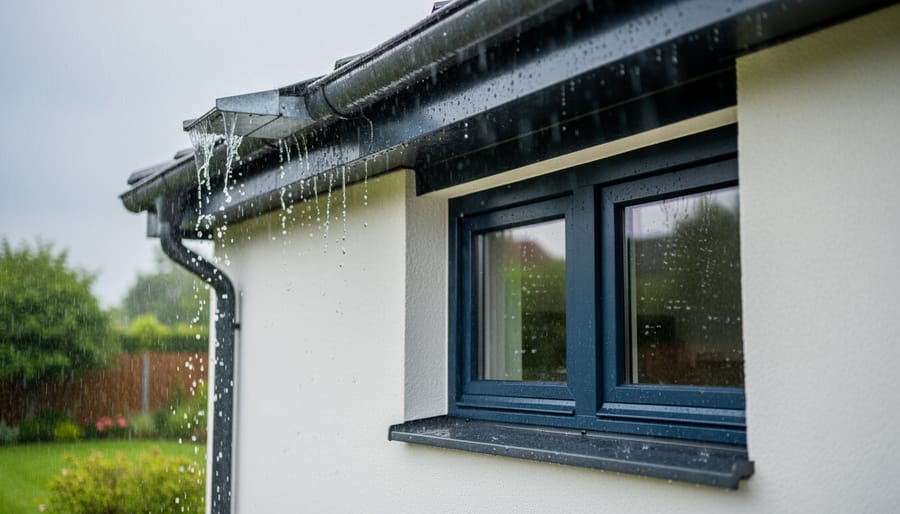
Modern moisture barriers operate through two fundamentally different approaches depending on structural requirements. Impermeable systems use non-porous membranes, typically rubberized asphalt, EPDM sheets, or dense thermoplastic films, that block all water vapor transmission. These materials create absolute barriers essential for below-grade foundations and areas with sustained hydrostatic pressure, where any moisture penetration risks structural damage or interior flooding.
Breathable barriers represent a more nuanced technology. These weatherproof materials incorporate microporous structures or selective polymer formulations that permit water vapor to escape from wall cavities while still repelling liquid water. The mechanism relies on molecular size differentiation: water vapor molecules (approximately 0.0004 microns) pass through microscopic pores that liquid water droplets (1000+ microns) cannot penetrate. This prevents trapped moisture from condensing inside wall assemblies, which would otherwise cause mold growth, insulation degradation, and structural rot.
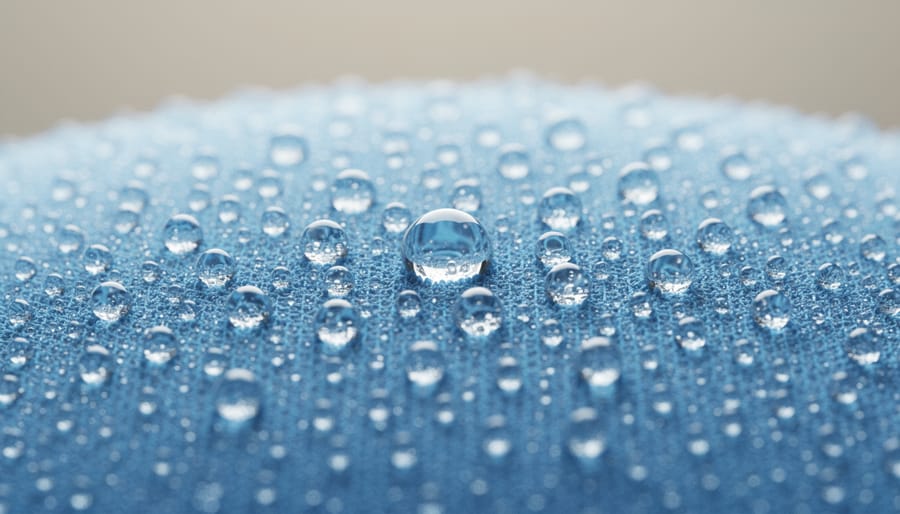
Hydrophobic treatments enhance both barrier types through surface chemistry modifications. Silane, siloxane, and fluoropolymer coatings create surfaces with extremely high contact angles, often exceeding 110 degrees, causing water to bead and shed rather than spread and absorb. Advanced formulations now penetrate substrate surfaces to provide molecular-level water repellency without forming an impermeable film, allowing the underlying material to breathe while remaining protected.
UV and Temperature Resistance
UV radiation and thermal cycling pose significant challenges to exterior materials, but modern weatherproofing products address these through deliberate chemical engineering. Advanced formulations incorporate UV stabilizers, compounds that absorb or reflect harmful wavelengths before they can break down polymer chains. These stabilizers, often hindered amine light stabilizers (HALS) or carbon black pigments, interrupt the photodegradation process that causes fading, chalking, and embrittlement.
Cross-linked polymer structures provide the foundation for temperature resistance. During manufacturing, polymer chains form chemical bonds that create a three-dimensional network. This molecular architecture allows materials to expand and contract with temperature fluctuations without losing cohesion. Where conventional materials develop stress cracks after repeated freeze-thaw cycles, cross-linked elastomers maintain elasticity across temperature ranges from -40°F to 180°F.
The combination proves critical for roofing membranes and exposed wall coatings. A dark-colored roof surface can reach 170°F on summer afternoons, then drop to ambient temperatures overnight, cycles that would fracture rigid materials within months. Properly stabilized weatherproof coatings endure these conditions for decades, maintaining their protective barrier without reapplication.
Categories of Weatherproof Exterior Materials
Elastomeric and Rubber-Based Coatings
Elastomeric and rubber-based coatings represent a critical category of weatherproofing materials engineered for applications demanding extreme flexibility and durability. These formulations derive their performance from long-chain polymer molecules that stretch and recover without permanent deformation, making them ideal for substrates that experience thermal expansion, structural settling, or vibration.
Thermoplastic elastomers combine the processing advantages of plastics with rubber-like elasticity. The TPE vs silicone comparison reveals TPE’s superior temperature range and resistance to UV degradation without the plasticizer migration issues that compromise some silicone applications. Modern TPE formulations maintain flexibility to -40°C while resisting thermal breakdown at sustained temperatures exceeding 90°C.
EPDM rubber membranes offer exceptional ozone and weathering resistance through their saturated polymer backbone, which lacks the vulnerable double bonds found in natural rubber. These materials bond tenaciously to concrete, metal, and prepared wood surfaces through mechanical interlocking at the microscopic level and chemical adhesion promoted by primers.
Synthetic rubber coatings, including butyl and neoprene formulations, excel in below-grade applications where hydrostatic pressure and constant moisture contact demand materials that maintain integrity without becoming brittle. Their elongation properties, often exceeding 300 percent, accommodate substrate movement that would fracture rigid waterproofing systems.
Modified Polymer Membranes
Modified polymer membranes represent a critical category of weatherproofing materials engineered for continuous barrier applications where seam integrity is paramount. These factory-manufactured sheets, typically ranging from 45 to 80 mils in thickness, provide uniform protection across large surface areas without the variability inherent in field-applied coatings.
Thermoplastic polyolefin (TPO) membranes combine polypropylene and ethylene-propylene rubber to create a single-ply roofing material with excellent UV resistance and heat-weldable seams. The thermoplastic nature allows installers to heat-weld overlapping sections, creating monolithic barriers that eliminate the mechanical fastener penetrations common in older systems. TPO performs reliably across temperature extremes from -40°F to 180°F, making it suitable for diverse climate zones.
Polyvinyl chloride (PVC) membranes offer similar heat-welding advantages with enhanced chemical resistance, particularly valuable near industrial areas or where biological growth poses risks. The plasticizers in PVC formulations provide flexibility while maintaining tensile strength exceeding 300 psi in quality products.
Substrate compatibility varies by membrane type. TPO adheres well to polyisocyanurate insulation and concrete, while PVC requires separation layers over asphalt-based materials to prevent plasticizer migration. Modified bitumen substrates demand careful primer selection to ensure long-term bond integrity without chemical interaction that could compromise either material layer.
Hybrid and Composite Systems
Hybrid and composite weatherproofing systems layer rubber, polymers, and fiber reinforcement to deliver protection that no single material achieves alone. These multi-component solutions combine the flexibility and adhesion of elastomers with the tensile strength of woven or nonwoven fabrics, creating membranes that resist tearing while accommodating structural movement. Common configurations include EPDM rubber bonded to polyester or fiberglass scrims, and thermoplastic sheets reinforced with aramid fibers for puncture resistance in high-traffic or mechanically demanding installations.
Manufacturers develop customized rubber formulations within these composites to address specific site conditions, freeze-thaw cycling in northern climates, salt spray exposure in coastal zones, or chemical contact in industrial-adjacent residential areas. The reinforcement layer prevents membrane elongation under stress, while the elastomeric surface maintains water-tight integrity across seams and penetrations. Advanced hybrid systems incorporate additional functional layers: UV-reflective top coats that reduce thermal load, self-adhesive backing that eliminates fastener penetrations, or vapor-permeable facings that allow moisture escape from wall assemblies. Specifiers select these engineered composites when standard single-material solutions cannot meet the combined demands of a challenging application.
Applications Across Home Exterior Systems
Roofing and Overhead Protection
Flat and low-slope roofing systems face constant exposure to standing water, freeze-thaw cycles, and ultraviolet bombardment that would destroy conventional materials within years. Membrane systems using thermoplastic polyolefin (TPO) or EPDM rubber deliver continuous protection by eliminating seams through heat-welded joints or adhesive bonding that creates monolithic barriers. These materials must withstand ponding water, standing moisture that remains for 48 hours or longer after rainfall, without degrading or allowing capillary infiltration through microscopic gaps.
Liquid-applied coatings offer seamless coverage over complex roof geometries where sheet membranes prove difficult to install. Elastomeric formulations containing acrylic or silicone polymers create flexible films that accommodate thermal expansion as temperatures swing from -40°C winters to +80°C summer surface readings. The coating thickness, typically 20-40 mils when cured, determines longevity and resistance to UV-induced chalking.
Flashing components at parapets, penetrations, and roof edges represent vulnerability points where most leaks originate. Pre-formed EPDM or TPO flashings with reinforced corners eliminate field-cut pieces that introduce inconsistency. For critical weatherproofing applications specifying compatible flashing materials from the same manufacturer as the primary membrane ensures chemical adhesion and uniform thermal movement across the entire roof assembly.
Vertical Surface Protection
Wall systems demand a layered approach to weatherproofing that balances moisture exclusion with controlled vapor transmission. The assembly typically begins with a water-resistive barrier (WRB) behind the cladding that sheds bulk water while allowing interior moisture vapor to escape, preventing condensation within the wall cavity. Modern synthetic housewraps and fluid-applied membranes have largely replaced felt paper, offering superior tear resistance and consistent coverage around penetrations.
Drainage planes create an essential air gap between the WRB and exterior cladding, allowing incidental moisture to drain downward and evaporate rather than being trapped against sheathing. Furring strips, specialized drainage mats, or textured membrane surfaces maintain this critical ventilation space. At transitions and terminations, rubber deflector strips and flexible flashings redirect water away from vulnerable joints where different materials meet.
Breathability becomes crucial in mixed-climate applications where seasonal vapor drive reverses direction. Specifiers must calculate the permeance of each layer to prevent moisture accumulation, particularly when exterior insulation is added. Closed-cell foam requires careful vapor profile management, while mineral wool maintains better vapor openness. Properly integrated weatherproofing coordinates with window and door flashings, foundation terminations, and roof interfaces to create a continuous drainage and drying path throughout the entire wall assembly.
Below-Grade and Foundation Applications
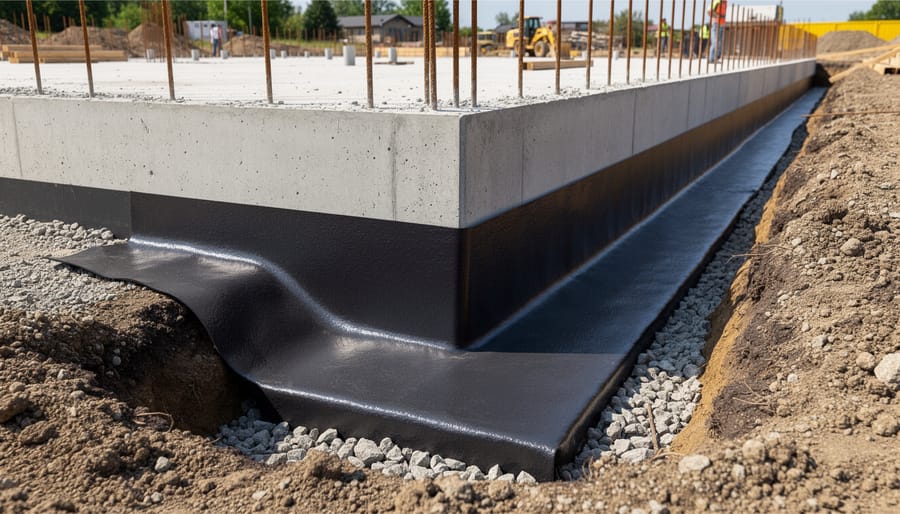
Below-grade waterproofing confronts challenges absent in above-ground applications: constant soil contact, hydrostatic pressure from groundwater, and minimal opportunity for inspection or repair once backfilled. Materials here must form continuous, puncture-resistant barriers that maintain integrity for decades under compression.
Rubberized asphalt membranes, modified bitumen enhanced with synthetic rubber polymers, dominate foundation waterproofing because they self-seal around fasteners and bond aggressively to concrete. Applied as sheet membranes or liquid coatings, they accommodate minor structural movement without cracking. Their rubberized content provides flexibility down to -40°F, critical during frost cycles.
Bentonite clay systems offer a different mechanism: sodium bentonite swells when wet, forming an impermeable gel layer against the foundation wall. Available as panels or spray-applied coatings, bentonite self-heals around penetrations as it hydrates. This passive system requires no curing time and works effectively in sites with high water tables.
Elastomeric membranes, EPDM rubber sheets or spray-applied polyurethanes, deliver superior elongation properties, stretching up to 300% without tearing. Engineers specify these for foundations subject to settlement or seismic movement. The seamless application of liquid elastomers eliminates vulnerable lapped seams present in sheet products, though proper surface preparation and thickness control become critical for performance.
Recent Innovations in Weatherproof Material Technology
Advanced Elastomer Formulations
Thermoplastic elastomer (TPE) formulations have undergone significant refinement since 2024, delivering weatherproof coatings with demonstrably longer field performance. Modern TPE compounds incorporate advanced cross-linking agents and chain extenders that create denser molecular networks, resisting oxidative degradation and maintaining flexibility through thousands of thermal cycles. These chemistry improvements translate to service life extensions of 30-50% compared to formulations from five years ago, reducing the frequency of recoating in demanding climates.
Low-temperature performance has advanced through incorporation of plasticizers that remain stable across broader temperature ranges without migrating from the polymer matrix. Current-generation elastomers maintain pliability to -40°F, preventing the brittleness and cracking that compromised earlier formulations during winter freeze-thaw cycles. This cold-weather flexibility proves critical for roofing membranes and foundation applications in northern climates.
Adhesion technology represents perhaps the most practical innovation: modified TPE surfaces now bond reliably to concrete, metal, wood, and existing coatings without separate primer application. Surface-active agents built into the elastomer chemistry create mechanical and chemical bonds simultaneously, eliminating a labor-intensive preparation step. High-performance applications increasingly specify specification rubber formulations when projects demand verified adhesion strength and documented longevity under continuous moisture exposure and UV stress.
Application and Installation Improvements
Installation methods for weatherproof materials have evolved significantly to address the field errors that historically compromised even the best material formulations. Modern application systems now incorporate technologies that reduce variability and ensure consistent protective coverage across entire exterior assemblies.
Spray-applied elastomeric systems represent a major advance in seamless barrier creation. Current generation equipment meters and mixes two-part formulations on-site with computerized precision, eliminating the ratio errors that once caused premature failures. These systems maintain consistent mil thickness through pressure regulation and spray-tip design, while rapid-cure formulations allow coating of complex geometries, pipe penetrations, corners, transitions, without sagging or running. Some spray systems now include tracer dyes that fade after UV exposure, giving installers immediate visual confirmation of complete coverage before the material cures.
Pre-formed components have incorporated integrated mechanical fastening that eliminates dependence on adhesive-only bonds. Thermoplastic membrane sheets now feature factory-attached fastening strips with engineered pull-out resistance, while corner and transition pieces include molded-in reinforcement zones that prevent stress concentration. These components arrive dimensionally stable and ready for heat welding or mechanical seaming, reducing on-site cutting and field fabrication errors.
Quality control technologies embedded in installation protocols include thermal imaging verification of membrane continuity, electronic mil-thickness gauges for coating systems, and photographic documentation requirements tied to warranty coverage. Contractors increasingly use moisture meters to verify substrate conditions before application, preventing the bond failures that occur when materials are applied over damp surfaces.
How Weatherproof Materials for Home Exteriors Works
Weatherproof materials function through multiple integrated mechanisms working simultaneously to shield exterior surfaces. At the molecular level, these materials create physical barriers that prevent water penetration while allowing vapor to escape, preventing trapped moisture that leads to structural decay.
The protection starts with the material’s base chemistry. Polymers and elastomers form continuous films or membranes with tightly bonded molecular chains. When properly applied, these chains interlock to create a flexible shield that moves with the substrate during thermal expansion and contraction. This flexibility prevents the cracking that allows water infiltration in rigid coatings.
UV stabilizers embedded throughout the material absorb and dissipate harmful radiation before it can break down the polymer structure. These additives essentially sacrifice themselves over time to protect the base material, extending service life significantly.
At the surface level, hydrophobic treatments repel water on contact, causing it to bead and run off rather than pool or penetrate. The material’s engineered texture and drainage properties direct water away from vulnerable joints and seams.
For below-grade applications, the material must also withstand constant hydrostatic pressure. Rubber-based membranes achieve this through their ability to stretch and conform to substrate movement while maintaining impermeability under sustained pressure loading.
Common Questions About Weatherproof Exterior Materials
Industry professionals frequently raise specific technical concerns when selecting weatherproof materials for exterior applications. Understanding these practical considerations helps ensure proper material specification and realistic performance expectations.
What service life can I expect from modern weatherproof exterior materials?
High-quality elastomeric and rubber-based systems typically deliver 15-25 years of reliable performance when properly installed, while premium modified polymer membranes can exceed 30 years in appropriate applications. Service life depends heavily on substrate preparation, environmental exposure severity, and adherence to manufacturer installation protocols.
How do I determine compatibility between weatherproofing materials and existing substrates?
Compatibility testing should verify adhesion strength, chemical interaction, and thermal expansion alignment between the weatherproofing material and substrate. Most manufacturers provide substrate compatibility charts, but custom formulations may require adhesion testing when working with unusual materials or retrofit applications over aged surfaces.
What temperature ranges are safe for application and long-term performance?
Application temperature windows vary by material type, with most liquid-applied systems requiring substrate temperatures between 40°F and 100°F, though some modified formulations expand this range. For service performance, quality materials maintain integrity from -40°F to 180°F, though specific products may offer extended ranges for extreme climate applications.
What maintenance do weatherproof systems require after installation?
Most modern systems need minimal maintenance beyond periodic visual inspection for mechanical damage or substrate movement that could compromise the barrier. Cleaning accumulated debris from drainage components and inspecting termination points and penetrations annually helps identify issues before they cause water intrusion.
Warranty structures vary significantly across material categories and manufacturers. Standard material warranties typically cover defects in the product itself for 10-15 years, while system warranties that include labor and consequential damage protection often require certified installer participation and adherence to specific installation details. Extended warranties generally demand more rigorous substrate preparation and may exclude certain high-risk applications or exposure conditions.
Cost-performance analysis should account for total installed cost rather than material price alone. A premium elastomeric system with a higher unit cost often delivers better value when its extended service life, reduced maintenance requirements, and lower failure risk are factored against cheaper alternatives that require earlier replacement. For critical applications where moisture intrusion consequences are severe, specifying proven materials with robust technical support and reliable supply chains outweighs marginal cost savings from untested alternatives.
Weatherproof materials for home exteriors represent far more than surface protection, they’re fundamental systems engineering that determines structural longevity and performance under environmental stress. Moisture intrusion remains the primary cause of premature building failure, making proper material selection and application critical to lifecycle cost management.
The technical advances in elastomeric formulations, polymer membranes, and hybrid systems have expanded the toolkit available to specifiers, but increased options demand more precise matching of material properties to site-specific conditions. Temperature ranges, UV exposure intensity, substrate movement characteristics, and hydrostatic pressure requirements all influence which weatherproofing solution delivers optimal performance. Generic approaches frequently underperform in specialized applications where thermal cycling, chemical exposure, or physical movement exceeds standard design parameters.
Consulting with material specialists who understand both the chemistry of weatherproofing systems and the mechanics of building envelope performance ensures specifications address actual field conditions rather than idealized scenarios. Custom formulations developed for unique environmental challenges, whether extreme temperature differentials, aggressive moisture loads, or compatibility with non-standard substrates, consistently outperform off-the-shelf alternatives in demanding installations.
Our commitment centers on developing weatherproofing solutions that withstand real-world conditions through rigorous material science and application-focused innovation, protecting your projects for decades of reliable service.
