
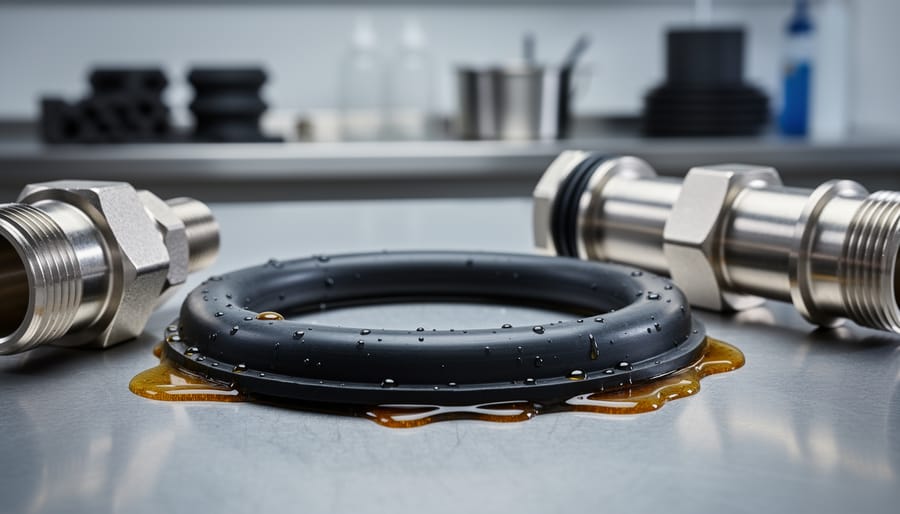
How to Select and Compound Oil Resistant Rubbers for Fuel and Chemical Exposure
Oil resistant rubbers are engineered elastomers formulated to maintain structural integrity and sealing performance when exposed to petroleum products, fuels, and industrial chemicals. The most effective compounds for oil resistance combine nitrile (NBR), hydrogenated nitrile (HNBR), or fluoroelastomers (FKM) with carefully selected fillers, plasticizers, and cross-linking agents that prevent swelling, degradation, and mechanical failure under continuous hydrocarbon exposure.
Selecting the right specification rubber begins with matching the polymer type to your specific service environment. NBR handles most mineral oils and fuels at temperatures up to 120°C, while HNBR extends that range to 150°C with superior heat aging resistance. For extreme conditions involving aggressive chemicals or temperatures exceeding 200°C, fluoroelastomers deliver the necessary chemical inertness, though at significantly higher material costs.
The compounding process requires balancing oil resistance with mechanical properties. Higher acrylonitrile content in NBR improves fuel resistance but reduces low-temperature flexibility. Carbon black loading affects both reinforcement and swell resistance, while plasticizer selection directly impacts extraction rates in service. Engineers must also account for compression set, which determines long-term sealing effectiveness in gaskets, O-rings, and shaft seals.
This guide walks through the complete formulation workflow, from polymer selection and compound design to mixing protocols, molding parameters, and ASTM testing verification. The structured approach addresses common formulation challenges, safety requirements for handling reactive curatives, and quality control benchmarks needed to qualify materials for automotive fuel systems, hydraulic seals, and chemical processing equipment.
Essential Materials and Equipment for Oil Resistant Rubber Compounding
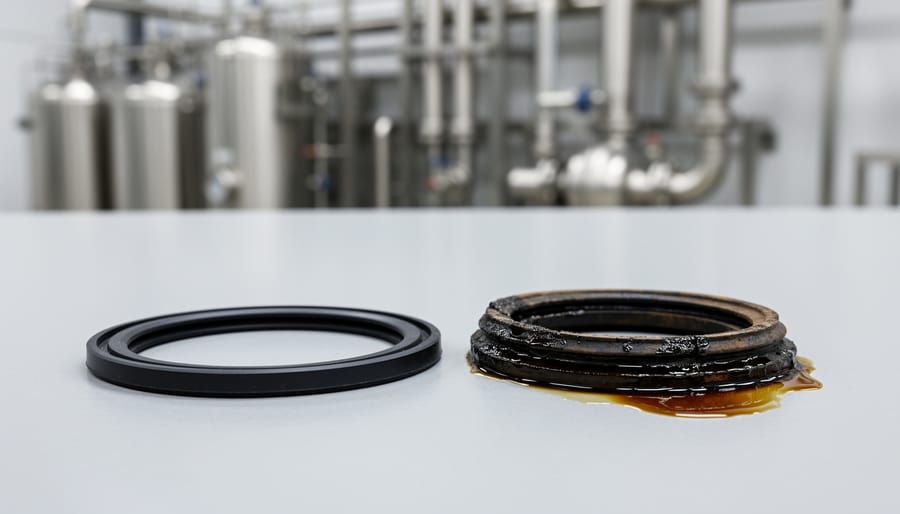
Base Elastomer Selection Criteria
Selecting the right base elastomer depends on three critical factors: the specific oils or fuels involved, operating temperature extremes, and secondary chemical exposures.
Nitrile rubber (NBR) remains the workhorse for general oil resistance. Acrylonitrile content determines performance, 18-22% ACN handles mild petroleum products, while 33-40% ACN provides excellent resistance to fuels, hydraulic oils, and aliphatic hydrocarbons. NBR operates effectively from -40°C to 120°C, making it suitable for most automotive and industrial applications. Cost-effectiveness drives its dominance in seals, hoses, and gaskets where temperature demands stay moderate.
Hydrogenated nitrile (HNBR) extends the temperature ceiling to 150°C while maintaining superior oil resistance. The hydrogenation process adds heat stability and ozone resistance that standard NBR lacks. Choose HNBR when applications involve high-temperature engine compartments, transmission systems, or exposure to hot hydraulic fluids. The price premium, typically 2-3 times NBR, limits use to demanding applications.
Fluoroelastomers (FKM) excel where extreme temperatures (-20°C to 200°C) or aggressive chemicals are present. FKM resists aromatic hydrocarbons, concentrated acids, and oxygenated fuels that attack nitrile compounds. The trade-off: FKM costs 5-10 times more than NBR and requires specialized processing equipment.
EPDM works for petroleum-based lubricants and phosphate ester fluids but swells severely in hydrocarbon fuels, reserve it for brake fluids and specific hydraulic applications where fuel contact won’t occur.
Match the elastomer’s chemical resistance profile to your fluid exposure matrix before optimizing for temperature or cost.
Compounding Additives and Their Functions
Fillers form the backbone of mechanical reinforcement in oil resistant compounds. Carbon black (N330, N550 grades) provides tensile strength and abrasion resistance while maintaining reasonable oil resistance. Silica fillers offer improved heat resistance and lower compression set in high-temperature fuel environments, though they require silane coupling agents for proper dispersion. Clay and talc serve as cost-effective extenders but increase volume swell in aggressive fuels.
Antioxidants prevent degradation during heat aging and chemical exposure. Amine-based antioxidants (6PPD, IPPD) protect against oxidative attack but may discolor and stain. Hindered phenolics offer non-staining protection suitable for light-colored compounds. Phosphite antioxidants work synergistically to control peroxide decomposition during fuel exposure.
Plasticizers modify processability and low-temperature flexibility. Aromatic oils reduce production costs but compromise oil resistance. Specialty esters and adipates maintain flexibility after fuel immersion, though they migrate less readily than conventional plasticizers. Polymeric plasticizers provide permanent flexibility with minimal extraction in aggressive solvents.
Curing systems dramatically affect oil resistance. Sulfur-based cures offer economical processing but limited heat aging. Peroxide cures deliver superior compression set and fluid resistance at elevated temperatures. Coagent additions with peroxide systems enhance crosslink density and reduce extractables, critical for automotive fuel system applications where dimensional stability determines seal integrity.
Safety Requirements and Precautions
Compounding oil resistant rubbers requires strict adherence to safety protocols due to the hazardous nature of raw materials, processing equipment, and testing fluids. Many compounding ingredients, particularly curing agents, accelerators, and plasticizers, present significant health risks through skin contact, inhalation, or ingestion.
All personnel must wear appropriate personal protective equipment before handling materials or operating equipment. This includes nitrile or neoprene chemical-resistant gloves rated for the specific compounds in use, safety glasses with side shields, and closed-toe steel-toed footwear. When working with fine powders or during mixing operations, add respiratory protection (minimum N95, or a supplied-air respirator for highly toxic materials) and a lab coat or chemical-resistant apron.
Ensure adequate ventilation in all processing and testing areas. Internal mixers generate substantial heat and release volatiles during compounding, requiring local exhaust ventilation with a minimum of 10 air changes per hour. Position fume hoods over two-roll mills and maintain negative pressure to capture emissions at the source rather than allowing dispersion throughout the workspace.
Store chemicals according to their Safety Data Sheets, separating incompatible materials such as peroxides from sulfur-based systems. Keep flammable plasticizers in approved cabinets away from ignition sources. Establish clear labeling protocols for all containers, including partially used materials transferred from original packaging.
Prepare for emergencies by maintaining accessible eyewash stations and safety showers within 10 seconds of any chemical handling area. Keep spill kits containing absorbent material, neutralizing agents, and disposal bags near mixing equipment. Train all personnel on emergency response procedures, including chemical spill containment, first aid for chemical burns, and evacuation routes. Post emergency contact numbers and material-specific response instructions visibly throughout the facility.
Step-by-Step Oil Resistant Rubber Compounding Process
Formulation Design for Specific Oil Exposure
Formulation design begins with matching the acrylonitrile (ACN) content in nitrile rubber to the specific oil or fuel exposure. For gasoline and low-aromatic fuels, 33-38% ACN content provides adequate resistance while maintaining flexibility. Medium oils and diesel fuels require 38-43% ACN, and high-aromatic fuels or concentrated hydraulic fluids demand 43-50% ACN for minimal swell. Each 5% increase in ACN content reduces volume swell by approximately 15-20% but raises the compound’s glass transition temperature and stiffness.
Cure system selection directly impacts oil resistance retention. Peroxide cures deliver superior heat aging and compression set resistance in hot oil environments, making them ideal for under-hood automotive applications above 120°C. Sulfur-based cures offer better low-temperature flexibility and are suitable for ambient or moderately heated applications. Semi-EV (efficient vulcanization) systems with 0.5-1.0 phr sulfur and accelerator ratios of 1:1 provide the best balance for most fuel system applications.
Balancing oil resistance with mechanical properties requires trade-offs in filler loading and plasticizer type. Carbon black loadings between 50-70 phr maintain tensile strength while allowing necessary flexibility for dynamic seals. Avoid aromatic or ester plasticizers in oil-contact formulations; instead, use polymeric plasticizers or low-molecular-weight NBR at 5-15 phr to maintain processability without compromising swell resistance. For applications requiring both fuel resistance and low-temperature flexibility, blend high-ACN NBR with 10-20% low-ACN grade to achieve dual performance objectives.
Mixing Sequence and Parameter Control
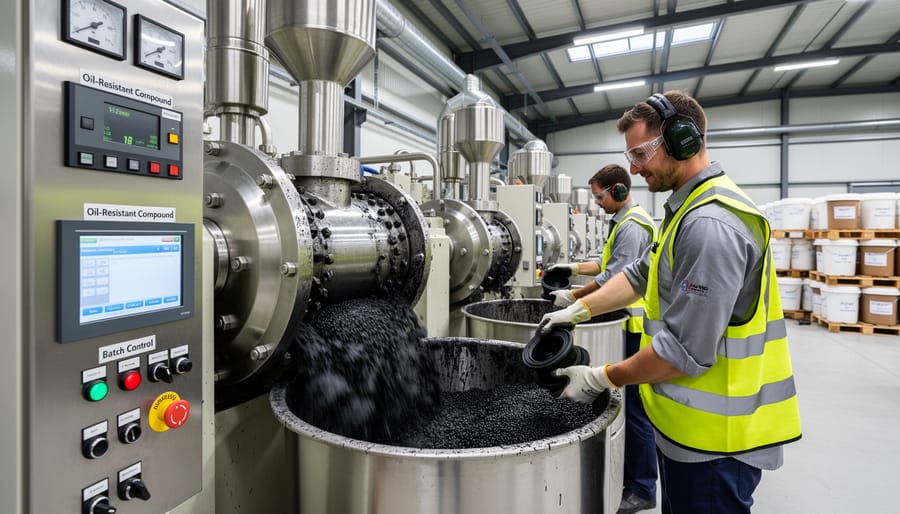
The mixing sequence for oil resistant rubber compounds requires strict control to achieve uniform dispersion while preventing degradation. Start by preheating the internal mixer chamber to 40-50°C to ensure consistent batch temperature from the first ingredient addition.
Add the base elastomer (NBR, HNBR, or FKM) first and masticate for 1-2 minutes at 30-40 rpm until the rubber reaches a plastic state. Introduce half the carbon black or silica filler at low rotor speed (20-30 rpm) to prevent dust emissions and allow initial incorporation. Once integrated, add the remaining filler along with plasticizers and processing aids. Increase rotor speed to 50-60 rpm and mix for 3-4 minutes, monitoring dump temperature closely, target 100-110°C for NBR compounds, 110-120°C for HNBR.
Add antioxidants and antiozonants when the batch reaches 80-90°C to maximize dispersion without thermal degradation. Maintain mixing until you achieve a homogeneous compound, typically 8-12 minutes total mixing time. Dump the batch when temperature reaches the target range; exceeding 130°C risks pre-scorch and compromises oil resistance.
For two-roll mills, set nip gap at 1.5-2.5mm and maintain roll temperature at 50-70°C. Feed elastomer first, form a rolling band, then add ingredients in the same sequence used for internal mixers. Cut and fold the compound 15-20 times to ensure thorough blending, proper processing techniques prevent batch-to-batch variation.
Add curatives only in a separate final mixing pass at temperatures below 100°C to prevent premature vulcanization. Allow the compound to cool on the mill before sheeting off at 2-3mm thickness for storage and subsequent processing.
Curing and Post-Cure Processing
Curing temperature and time directly determine crosslink density, which controls oil resistance and dimensional stability. For NBR compounds, optimal cure typically occurs at 160-170°C for 10-15 minutes, depending on part thickness. HNBR requires slightly higher temperatures (170-180°C) due to its saturated backbone, while FKM demands 177-204°C with extended cure cycles of 10-30 minutes. Monitor cure state using rheometer data; undercuring leaves excess free polymer chains that absorb oil, while overcuring creates brittle networks prone to cracking.
Post-cure treatment eliminates residual peroxide or volatiles that compromise chemical resistance. Heat aged parts at 150-200°C for 4-24 hours in circulating air ovens, with exact conditions depending on polymer type and cure system. HNBR peroxide cures benefit most from extended post-cure, reducing compression set by 30-40% and improving fuel resistance. FKM compounds require post-cure to complete crosslinking and volatilize fluorinated byproducts.
Cool parts gradually after post-cure to prevent thermal shock and dimensional warping. Record actual time-temperature profiles for each batch to ensure consistency. Parts meeting dimensional tolerances immediately after cure may still require post-cure to achieve specified oil swell limits and service life durability.
Custom Solution Development
Modifying base formulations begins with a thorough analysis of the customer’s specific exposure environment. Document the exact fuel blend composition, operating temperature range, and any secondary chemical contacts. For multi-fuel applications, test against the most aggressive component first, if the compound resists biodiesel blends (B20-B100), it typically handles conventional petroleum fuels.
Temperature extremes require adjusting both the elastomer and cure system. For high-temperature fuel exposure above 150°C, shift from standard NBR to HNBR or incorporate heat-resistant fillers like calcined clay. Low-temperature requirements demand plasticizer selection that won’t migrate during oil immersion while maintaining flexibility below -40°C.
Multi-chemical exposure scenarios need careful compatibility mapping. Create a matrix testing each chemical individually, then verify the compound against combined exposure. Hydraulic fluids mixed with engine oils, for instance, may require FKM-based formulations rather than NBR. Always validate the modified formulation through accelerated aging tests that simulate the customer’s actual service conditions before scaling to production quantities.
Testing and Performance Verification Methods
Immersion Testing Protocols
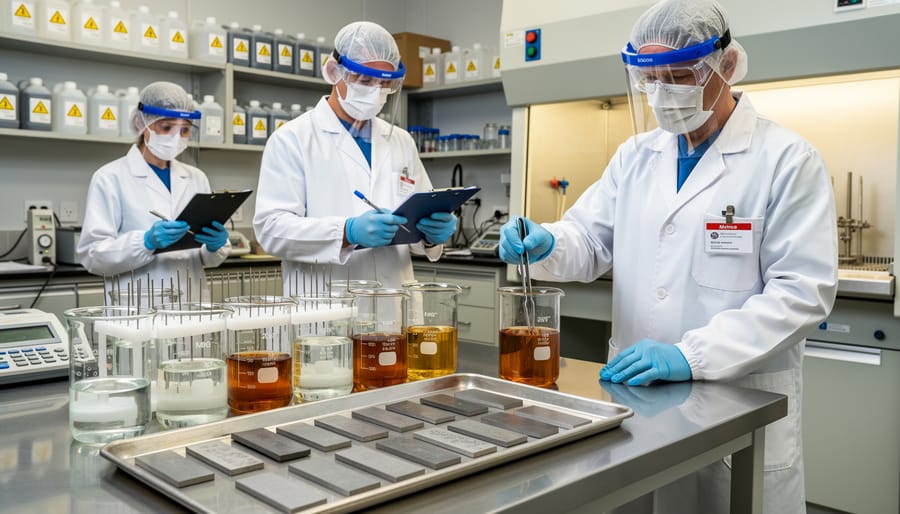
Immersion testing validates oil resistance by exposing cured rubber specimens to actual service fluids under controlled conditions. ASTM D471 provides the standard methodology, but successful testing requires meticulous attention to specimen preparation and measurement protocols.
Prepare test specimens as 25mm diameter disks or 25mm × 25mm × 2mm sheets, cutting from fully cured slabs that have completed post-cure. Remove flash and surface irregularities with fine sandpaper to prevent measurement errors. Record initial measurements immediately: volume using water displacement in a graduated cylinder, mass on an analytical balance accurate to 0.001g, and Shore A hardness at five points per specimen. Calculate initial volume from displaced water mass, assuming 1.000g/mL density at room temperature.
Select test fluids matching the application environment, ASTM No. 3 oil for general petroleum resistance, gasoline blends for automotive fuel systems, or customer-specified chemicals. Pre-condition specimens by storing at 23°C for 24 hours before immersion. Fully submerge specimens in individual glass containers with fluid volume at least 10 times the specimen volume to prevent depletion effects.
Control exposure temperature using constant-temperature ovens or baths, typically 70°C, 100°C, or 125°C depending on service conditions. Standard exposure durations are 70 hours for initial screening, 168 hours for qualification testing, or 1000+ hours for long-term performance validation.
Remove specimens at designated intervals, blot surface fluid with clean absorbent paper within 30 seconds, and immediately measure volume and mass. Return specimens to fluid within 3 minutes to minimize evaporation effects. Record hardness after specimens reach room temperature equilibrium, approximately 30 minutes post-removal.
Interpreting Results and Next Steps
Compare immersion test results directly to your specification limits for volume swell, hardness change, and tensile property retention. If volume swell exceeds your target, say, more than 10% for NBR in gasoline, increase the acrylonitrile content by 5% increments or switch to HNBR. Hardness loss greater than 10 points signals excessive plasticizer extraction; reduce plasticizer levels or select higher molecular weight alternatives. Track compression set alongside swell data, because a compound that passes swell limits may still fail if permanent deformation exceeds 25%.
Document all formulation changes with batch numbers and test dates. Run confirmatory tests on adjusted compounds using the same exposure conditions to verify improvement. When results consistently meet specifications across three validation batches, scale the formulation to production quantities while maintaining identical mixing sequences and cure parameters.
Schedule pre-production trials with your processing equipment to confirm the compound flows, cures, and demolds as expected at full scale. Minor adjustments to mixing time or mill temperature may be needed during scale-up. Establish incoming inspection protocols for raw materials, particularly acrylonitrile content in NBR lots, to maintain batch-to-batch consistency.
Create a formulation record that includes raw material specifications, mixing instructions, cure conditions, and acceptance criteria. This documentation ensures that quality defines success through repeatable manufacturing processes and traceable material performance data that supports customer approvals.
Common Compounding Challenges and Solutions
Excessive volume swell in fuel immersion tests typically indicates insufficient acrylonitrile content or incompatible plasticizer selection. If NBR compounds exceed 10% volume swell in your target fuel, increase ACN content by 5-10 points or switch to HNBR for temperatures above 125°C. Polar plasticizers like adipates reduce swell but may compromise low-temperature flexibility, balance this trade-off based on your operating range.
Hardness loss after thermal aging reveals inadequate antioxidant protection or overcure. Add 1.5-2 phr phenolic antioxidant for continuous exposure above 100°C. If hardness drops more than 10 points during ASTM D573 aging, verify your cure state isn’t past the optimum; excessive crosslink density accelerates degradation through chain scission.
Poor compression set, particularly above 30% after 70 hours at application temperature, signals cure system imbalance. Peroxide cures deliver superior set resistance compared to sulfur systems for oil resistant applications. Switch to 1.5-2 phr dicumyl peroxide with 2-3 phr coagent (TAIC or TMPTMA) for demanding seal applications. Ensure post-cure reaches 4 hours at 175°C to complete crosslinking.
Processing difficulties during mixing or calendering often stem from polymer viscosity mismatches. If internal mixer temperatures exceed 140°C during incorporation, reduce rotor speed by 10-15 rpm or add ingredients in smaller increments. Scorching during processing means accelerator loading is too aggressive, reduce CBS or TMTD by 0.2-0.3 phr and extend scorch time with retarder like PVI.
When you formulate compounds for simultaneous oil resistance and mechanical performance, carbon black type matters significantly. N330 provides better abrasion resistance than N550, but higher structure blacks increase oil uptake. Test alternative loadings, drop from 60 to 50 phr and add 10 phr silica to maintain reinforcement while improving fluid resistance. Document each adjustment with side-by-side immersion testing to validate improvements before scaling to production batches.
Frequently Asked Questions
What acrylonitrile content should I choose for automotive fuel system applications?
For gasoline and diesel fuel exposure, NBR compounds with 33-36% acrylonitrile content typically provide the best balance of oil resistance and cost-effectiveness. Higher ACN levels (40-45%) are necessary for biodiesel blends or synthetic lubricants, though they reduce low-temperature flexibility and increase material costs.
How do I know if FKM is worth the cost premium over HNBR?
FKM justifies its higher cost when continuous operating temperatures exceed 150°C, when exposure involves aromatic hydrocarbons or aggressive fuel additives, or when zero tolerance exists for dimensional changes. For standard fuel hoses and seals operating below 120°C, HNBR often delivers comparable real-world performance at 40-60% lower material cost.
Can I use the same compound for both mineral oils and modern fuel ethanol blends?
Standard NBR compounds formulated for petroleum products often fail rapidly in ethanol-blended fuels due to increased polarity and water absorption. You need specific formulations with reduced plasticizer content and modified cure systems, or consider switching to FKM for E85 applications where ethanol content reaches 85%.
What causes compression set failure in oil resistant seals?
Excessive compression set typically results from overcure or undercure conditions, plasticizer extraction during oil exposure, or thermal degradation from operating temperatures near the polymer’s upper limit. Verify your cure state through rheometer testing and consider post-cure heat treatment to stabilize seal performance before assembly.
These questions reflect the technical concerns engineers face when selecting materials for demanding chemical exposure applications. Each answer provides specific numerical guidance rather than vague recommendations, enabling faster decision-making during compound development. The trade-offs between cost and performance become clearer when you understand how acrylonitrile levels, temperature ranges, and fuel chemistry interact with base polymer selection and curing parameters.
