
What Is Rubber Compression Set (and How Does It Work)?
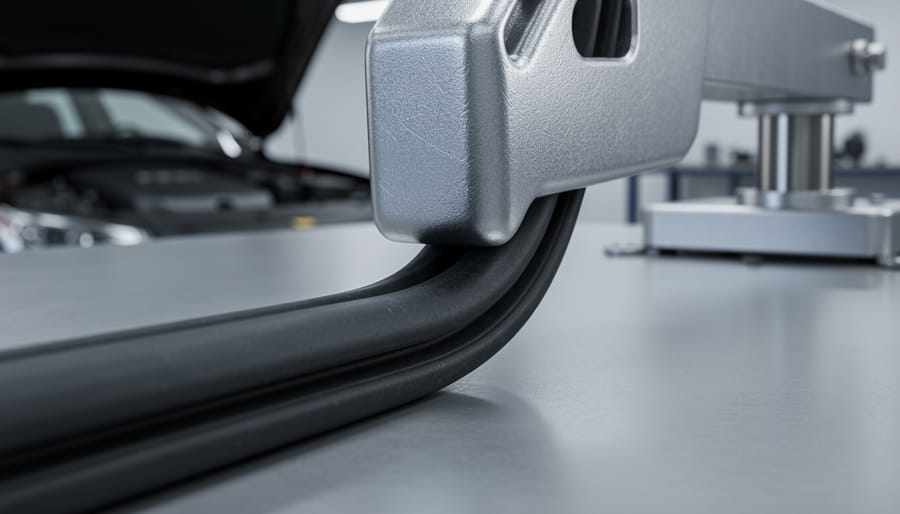
Compression set is the permanent deformation a rubber part retains after being held under sustained compressive load and then released. In practical terms, it measures how much of its original thickness a seal, gasket, or mount fails to recover. A low value means the compound keeps pushing back against mating surfaces. A high value means the part has taken a permanent set, and sealing force is gone.
That distinction decides whether a component lasts or leaks. In automotive and other high-wear applications, seals and mounts sit under constant strain, often at elevated temperatures and in contact with fluids, so recovery behavior drives service life far more than initial hardness or tensile strength. Compression set is typically evaluated under controlled conditions of time, temperature, and deflection, which makes it a reliable way to compare compounds before they reach the field.
This article explains how compression set develops, which factors influence it, and where it matters most. It also covers how formulation choices reduce it, and why specification rubber engineered to a defined set of requirements consistently outperforms off-the-shelf material when the application is critical and failure is costly.
What Rubber Compression Set Means
Compression set is the percentage of deflection a rubber part fails to recover after a compressive load is removed. A lower value means better recovery, so a seal that springs back close to its original thickness has a low compression set and keeps pushing against its mating surfaces.
This is different from the properties most people check first. Hardness shows how firmly a compound resists indentation, and tensile strength shows how much pulling force it takes to break. Compression modulus describes how stiff the part feels as it is squeezed. None of these tell you what happens after weeks or months under load. A compound can be hard, strong and stiff, yet still take a permanent set that leaves a gasket loose. That is why a low compression set is a primary indicator of long-term sealing performance.
The terms below appear throughout the article:
- Compression set
- The portion of an applied deflection that is not recovered after the load is released, reported as a percentage of the original deflection.
- Permanent set
- The lasting deformation that remains in a rubber part after the load and recovery time have passed.
- Stress relaxation
- The gradual drop in the force a compressed rubber exerts while held at constant deflection.
- Crosslink density
- The number of chemical bonds linking polymer chains in a compound, which governs stiffness, elasticity and thermal stability.
- Sealing force retention
- The ability of a compressed part to maintain contact pressure against a mating surface over its service life.
- Elastic recovery
- The degree to which a rubber returns to its original shape after deformation.
Keep these definitions in mind as we move from what compression set is to how it develops, how it is measured, and how formulation choices change it.
How Compression Set Develops Under Load, Heat, and Time
Physical and Chemical Mechanisms Behind Permanent Set
Permanent set has two distinct origins, and a compound’s behavior in service depends on which one dominates.
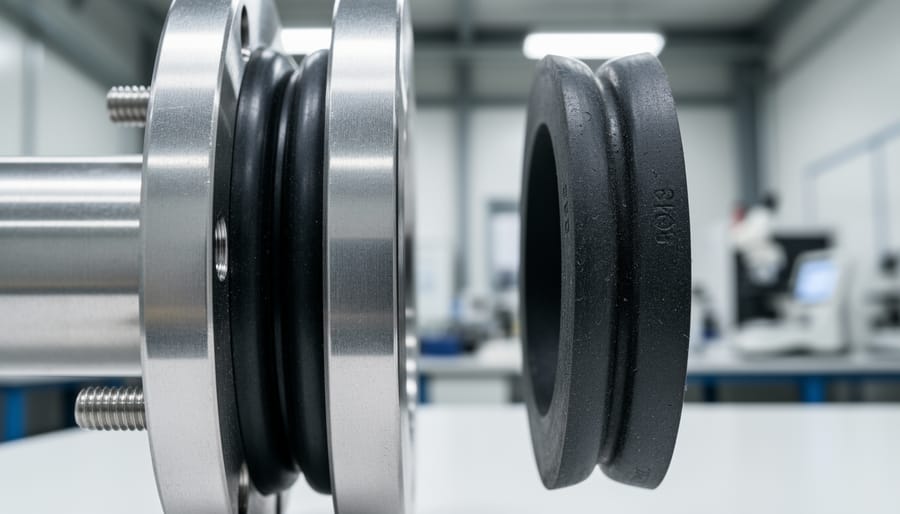
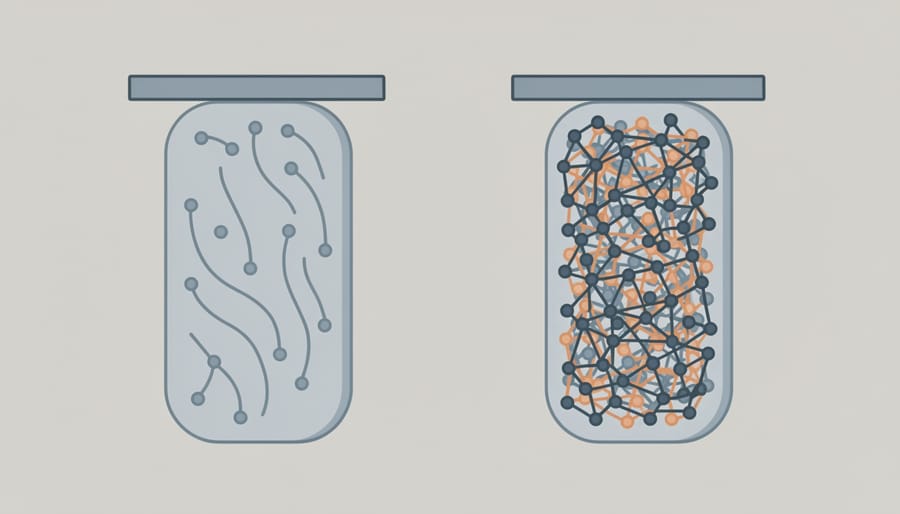
The first is physical relaxation. When a rubber part is held under compression, the polymer chains between crosslinks gradually rearrange to relieve stress. Entanglements slip, chain segments reorient, and the filler network, particularly carbon black or silica structures, breaks and re-forms in the deformed geometry. When the load is removed, the material no longer returns fully to its original shape because the network has settled into a new stress-free configuration. This mechanism is time-dependent but largely reversible with heat, and it tends to control set at lower temperatures.
The second origin is chemical change. Under heat and oxygen, existing crosslinks can break down, especially the polysulfidic links produced by conventional sulfur cure systems. Chain scission cuts the network itself, while continued crosslinking can lock the rubber into its deformed shape. In both cases the network is rebuilt in the compressed state, so the set is permanent. Oxidation and fluid attack, such as swelling or extraction of plasticizers and antidegradants, accelerate these reactions.
Four variables drive the rate. Higher temperature speeds both mechanisms but favors chemical change. A larger compression ratio increases stress and therefore relaxation. Longer exposure time allows more of either process to occur. Fluid contact adds chemical degradation and can strip protective ingredients. This is why a compound that performs well at ambient temperature may fail at elevated service temperature.
How Compression Set Is Measured
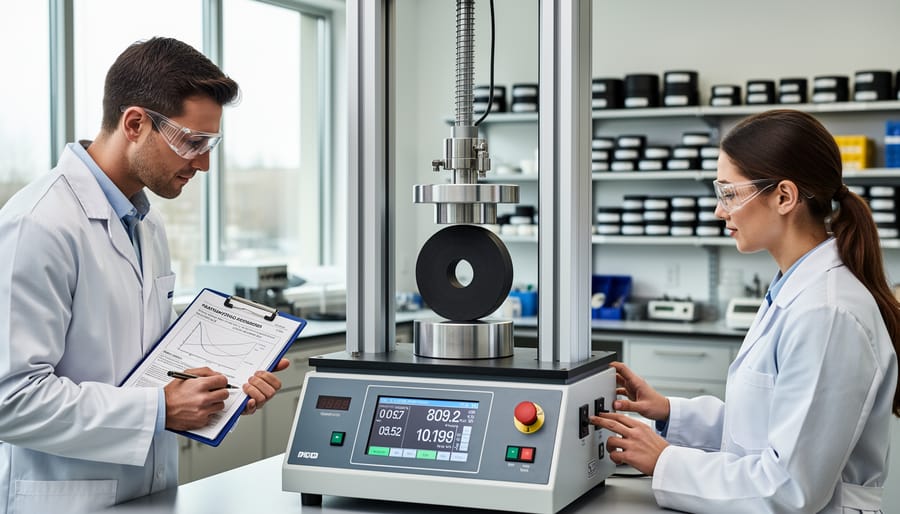
Compression set is measured by squeezing a standard specimen to a fixed deflection, holding it under heat for a set time, then measuring how much thickness it fails to recover. The two most widely referenced methods are ASTM D395 and ISO 815.
ASTM D395 defines two approaches. Method A, compression set under constant force, loads the specimen with a specified force. Method B, compression set under constant deflection, holds the specimen at a fixed strain using spacers between steel plates, and it is the more common choice for seals and gaskets. Typical specimens are small cylindrical buttons, and the standard deflection is 25 percent. ISO 815 follows a similar principle, with its own specimen dimensions and test-condition tables.
Temperature and duration are set to reflect the application, commonly ranging from room temperature to elevated levels over 22 to 70 hours or longer. After the exposure, the specimen is released and left to recover for a defined period, typically 30 minutes, before the final thickness is measured. The result is expressed as the percentage of the applied deflection that was not recovered, so a lower value means better recovery.
A number alone means little without its conditions. Two compounds can rank differently at 70 degrees C than at 150 degrees C, because the dominant mechanism shifts with heat. Always compare results generated at the same compression ratio, temperature, duration, and fluid exposure, and choose test conditions that mirror the service environment. Only then does the value predict long-term sealing force retention.
Types of Compression Set Behavior and the Compound Factors That Drive It
Elastomer Families and Their Set Resistance
Compression set resistance varies widely by polymer family, and the right match depends on the temperature window and the fluids the part will see.
EPDM performs well in hot water, steam, and weathering exposure, and it holds its recovery in heat, particularly when peroxide-cured. It is a poor choice with petroleum oils and fuels, which swell it and undermine sealing force. Nitrile (NBR) is the workhorse for oil and fuel contact, with moderate set resistance that declines as temperatures climb. Hydrogenated nitrile (HNBR) keeps that fluid compatibility but adds better heat and oxidation stability, so it retains recovery longer in hot, oily service.
Silicone is known for low set across a very broad temperature range, including cold flexibility, though it has limited tear strength and is not suited to many fuels and oils. Fluoroelastomer (FKM) offers strong set resistance at high temperature combined with excellent chemical and fuel resistance, which is why it appears in demanding powertrain seals. Natural rubber recovers well at moderate temperatures and under dynamic loading, but it ages quickly with heat, ozone, and oil exposure.
Thermoplastic elastomers (TPEs) bring processing and design advantages: faster cycle times, overmolding, and recyclability. Because their physical network softens as temperature rises, they typically show higher set under sustained load and heat. Thermoset rubbers, with permanent chemical crosslinks, remain the stronger choice for long-term compressive sealing. For a closer look at one common trade-off, see this comparison of TPE vs silicone.
Formulation Variables That Drive Set
Compression set is rarely fixed by a single change. It results from several formulation levers working together, and each one trades recovery against other properties.
- Cure system: peroxide cures form thermally stable carbon-carbon crosslinks that resist set at high temperature, while efficient vulcanization sulfur systems favor monosulfidic links over the weaker polysulfidic ones of conventional sulfur cures.
- Crosslink density: a tighter network improves elastic recovery, but too much raises hardness and cuts tear strength and elongation.
- Filler type and loading: reinforcing fillers raise strength, yet high loadings can build filler networks that rearrange under load and increase set.
- Plasticizer content: oils ease processing and lower hardness, but they can extract or migrate in service and let set creep upward.
- Antioxidants and antidegradants: these slow oxidative chain scission and crosslink breakdown, preserving recovery during long heat exposure.
- Post-cure: a secondary heat cycle completes crosslinking and drives off volatile by-products, which typically stabilizes set, especially in peroxide-cured and silicone compounds.
The trade-offs are real. A peroxide-cured compound may deliver excellent heat set resistance yet show lower tear strength than its sulfur-cured counterpart. Likewise, stiffening a compound to cut set can complicate molding and flow. Polymer choice shapes these decisions too. When fuel or chemical contact drives the specification, the formulation window for oil-resistant rubbers narrows, and plasticizer and filler choices must account for extraction. Parts that also face sliding contact must balance set against abrasion resistance since the filler loading that helps one can compromise the other.
Rubber Associates addresses this balance through custom formulation, adjusting each lever against the application’s actual temperature, fluid, and load profile.
Strategies for Compression Set Optimization in Rubber Compounds
Lowering compression set starts with a clear definition of the service envelope: peak and continuous temperature, fluid exposure, compression ratio, and expected life. Every formulation decision that follows is a trade against that envelope.
Match the base polymer to the environment. No amount of compounding fixes a polymer that is wrong for the job. A material that tolerates the temperature and swells minimally in the working fluid gives the formulator a workable starting point. Choosing a polymer with margin above the maximum service temperature is usually cheaper than trying to compensate later.
Tune the cure system toward stable crosslinks. Crosslink type matters as much as crosslink count. Peroxide and efficient-vulcanization systems form carbon-carbon or short sulfur bonds that resist breakdown under heat, while conventional polysulfidic networks tend to rearrange and relax. Adjusting cure level also matters: undercured compounds retain too much free chain mobility, while overcure can embrittle the part and hurt tear strength.
Control fillers and plasticizers. Filler type and loading affect both recovery and thermal stability, so reinforcement should be sized to the hardness the design actually needs. Plasticizers soften a compound cheaply but can migrate or volatilize in service, leaving a part that shrinks and loses sealing force. Keep levels as low as processing allows and select grades with low volatility.
Apply post-cure. A controlled post-cure drives off volatile cure by-products and completes crosslinking, which is especially valuable for peroxide-cured and fluoroelastomer compounds. It stabilizes properties before the part sees heat in service rather than letting the application finish the cure.
Validate and iterate. Test at the real service temperature, compression ratio, duration, and fluid contact, not just at a convenient standard condition. Each change to polymer, cure, filler, or post-cure shifts hardness, tear strength, and processability alongside set, so progress comes from short, controlled lab trials that vary one factor at a time and compare results side by side.
Consistent outcomes depend as much on process control as on chemistry. Tight management of mixing, dispersion, cure time, and temperature keeps a validated compound repeatable from batch to batch. That combination of materials innovation and disciplined processing is how a compound meets a compression set target and keeps meeting it in production.
How Compression Set Performance Is Used in Automotive and High-Wear Applications
Low compression set matters wherever a rubber part has to hold a seal or a position for years after it was first squeezed into place. A component that takes a permanent set loses the contact pressure that keeps fluid in and contaminants out, so the specification translates directly into service life, leak prevention, and warranty exposure.
In engine and powertrain systems, valve cover gaskets, oil pan seals, and transmission seals sit under constant compression while cycling through heat and hot oil. If set accumulates, the sealing force decays gradually, and a seepage path eventually opens along the flange. Door and window weatherstripping faces a different problem: moderate temperatures, but millions of years of closure cycles, ozone, and UV exposure. Here, poor recovery shows up as wind noise, water ingress, and rattles long before anything fails outright.
Vibration isolation mounts depend on recovery for geometry as much as for sealing. A mount that sets permanently changes ride height and alignment, shifting load paths and accelerating fatigue in adjacent parts. Hose and connector seals, particularly in coolant, fuel, and hydraulic circuits, must keep their interference fit through thermal cycling and chemical contact, where swell and extraction can compound the loss of sealing force.
Industrial gaskets in abrasive, high-load settings add further demands. Under conditions of extreme wear surface damage and compression loss tend to reinforce each other: a seal that has taken set no longer follows the mating surface, and the resulting micro-movement increases wear rates.
Requirements shift with the environment. A seal specified for a 100 °C engine-bay application is judged against a different test temperature and duration than one in a freezer-door gasket or a fuel-system connector. Fluid exposure changes the picture again, since the same polymer can show acceptable set in air and much higher set after immersion in oil or coolant. For that reason, acceptance limits should be written against the actual service temperature, compression ratio, and fluid, not a generic benchmark.
Warranty risk follows the same logic. A part that passes at room temperature but is never validated at operating temperature may enter service with a hidden failure mode. Matching the specification to the application envelope is the most reliable way to turn a compression set number into predictable field performance.
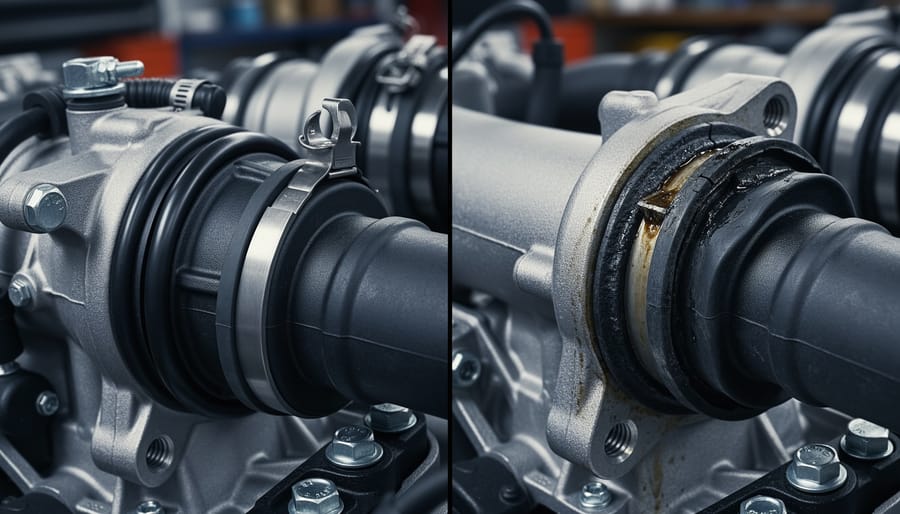
Custom Compound Development for Demanding Sealing Requirements
When a standard grade cannot hit a compression set target, a custom formulation process replaces guesswork with a defined sequence of decisions.
It starts with the application envelope. The engineer documents continuous and peak temperature, compression ratio, expected service life, fluid exposure, and any regulatory or dimensional constraints. A compression set target means little until it is tied to those conditions.
Next comes candidate polymer selection. Based on the envelope, the formulator narrows the field to a few base elastomers that suit the temperature range and fluid environment, then chooses starting cure systems and filler packages likely to favour recovery. Putting several candidates forward at this stage, rather than committing to one, keeps the program flexible.
Comparative testing follows. Candidate compounds are mixed in laboratory batches and tested against the incumbent grade under conditions that mirror service, using standard methods such as ASTM D395 or ISO 815. Results are read alongside hardness, tear strength, and processability, since a gain in recovery should not come at the cost of manufacturability.
Refinement is iterative. Cure system, crosslink density, filler loading, and post-cure are adjusted in small steps until the compound meets the target and the trade-offs are acceptable.
Throughout, Rubber Associates supports customers with consultation and responsive customer support, backed by a commitment to quality and ongoing investment in innovation.
Frequently Asked Questions About Rubber Compression Set
What counts as an acceptable compression set value?
There is no universal threshold, because acceptable values depend on the polymer, the service temperature, and how much sealing force the design can lose before leakage occurs. Lower is always better, so specifiers should set the target against the test conditions that mirror the real application, such as ASTM D395 Method B at the intended temperature and duration.
Does a harder rubber always have lower compression set?
No. Hardness and set are separate properties, and the cure system, crosslink density, and polymer type usually have a stronger influence on recovery. A harder compound with unstable crosslinks or heavy filler loading can still show poor recovery after prolonged heat.
How does temperature change compression set results?
Higher temperatures accelerate both physical relaxation and chemical changes such as chain scission and crosslink breakdown, so set values typically rise as test temperature increases. This is why results from room-temperature tests should not be used to qualify a compound for hot engine or powertrain service.
How is compression set different from stress relaxation, and when is a thermoplastic elastomer suitable?
Compression set measures how much deflection is permanently retained after the load is removed, while stress relaxation measures how quickly the sealing force decays while the part remains compressed. Thermoplastic elastomers suit applications with moderate temperatures and light sustained loads where processing efficiency matters, but thermoset rubbers generally remain the stronger choice for long-term compressive sealing.
Compression set is a direct measure of whether a rubber component keeps its sealing force over time. A low value means the part recovers after sustained load, which is what keeps seals tight, mounts stable, and gaskets leak-free through years of heat, pressure, and fluid exposure.
Getting there is never a single adjustment. Polymer choice, cure system, and filler design have to be decided together, then validated with test conditions that mirror the real service environment. Improving one property in isolation often costs another, so the balance matters as much as any individual number.
If your application demands tighter recovery than a standard grade can deliver, consult Rubber Associates. Our engineers develop custom rubber solutions tailored to automotive and high-wear requirements, built around your specific temperature, fluid, and load conditions.
